Cloud Kitchen App Development: Complete Guide for Restaurants in 2026

banner
August 11, 2026 On-Demand Solution
Summary: Cloud Kitchen App Development in 2026 will be of great help to restaurant owners and startups in terms of order management, kitchen management, delivery, payments, and customer interaction. With the use of artificial intelligence and other technologies, companies will become more efficient and cost-effective.
With AI advancements, Cloud Kitchen App Development has become one of the smartest investments for restaurants.
If you are a restaurant owner and have been facing problems such as high commissions from food delivery apps, poor order management, or difficulty developing a customer base.
Then, developing a Cloud Kitchen App is the best option for efficiently expanding your reach to customers.
With the rise of apps like Swiggy, Zomato, and Uber Eats, food business owners want a platform in which every order comes directly to their business.
For this, a custom cloud kitchen app is the best to have complete control over their brand, pricing, promotions, and customer experience. 

Key Takeaways:

The global cloud kitchen market is growing, with $88.7 billion in 2026, and projected to grow at 12.6% CAGR from 2026 to 2033, reaching $203.7 billion by 2033.

India’s cloud kitchen market is projected to reach $10.95 billion in 2026 and $28.57 billion by 2033, representing a 14.7% CAGR.

Multi-brand companies and cloud kitchens are the major growth drivers in the cloud kitchen industry.

51% of U.S. consumers say takeout or delivery is essential to their lifestyle.

28% of restaurant operators planned to invest in technologies such as AI to improve efficiency and off-premises operations

The popularity of “delivery-first” restaurants is on the rise due to increased online food ordering from consumers.
To compete, restaurants cannot rely solely on quality food but rather should develop a system that would connect all parties involved, from consumers to business owners and kitchen workers, via digital technology.
If you are planning to build cloud kitchen software, then you are at the right place. Our cloud Kitchen App Development guide will help your business understand what essential features your app should have, how the development process goes, what tech stack you must use, what it might cost you, and what new trends to look out in an app in 2026. 
Planning Your Cloud Kitchen App?

The pricing of your cloud kitchen app will depend on its features, number of apps, integration capabilities, technology stack, and business model.

Do not select an app development solution on the basis of a fixed price alone. Select a custom-made solution for yourself.

Contact RG Infotech to develop an app and know more about your cloud kitchen app concept, features, technology needs, and app development process.

What is Cloud Kitchen App Development?

A cloud kitchen app helps restaurant owners to manage their online food ordering on a digital platform. Customers can browse the restaurant food menus, place orders, make payments, and track their deliveries with the app.

Cloud Kitchen app development is a process of building software that becomes a central part of the food delivery operating model.
It allows restaurants to receive, process, organize, and deliver their orders without running a physical dine-in restaurant.
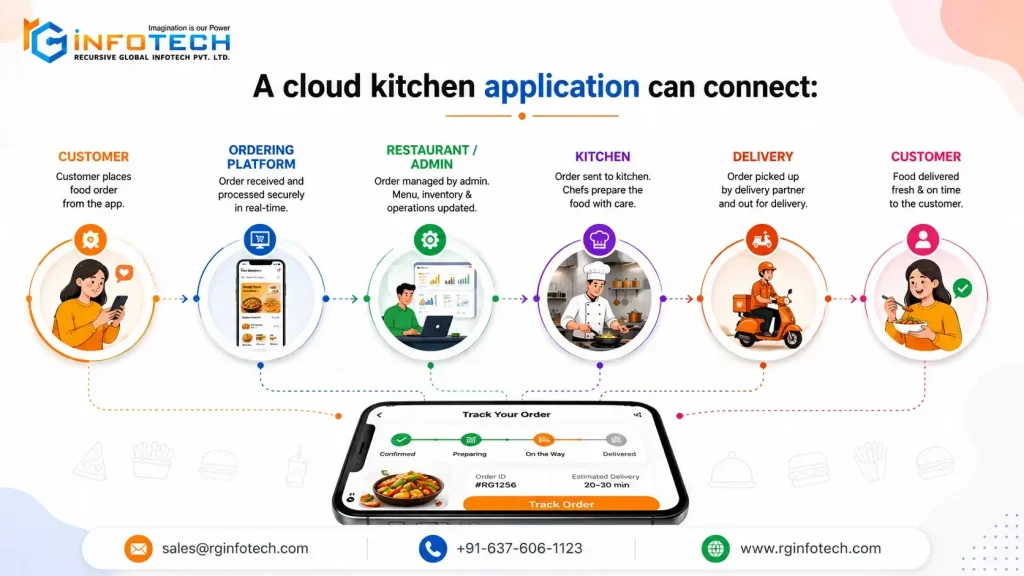
A cloud kitchen application
The software connects customers, kitchen staff, restaurant management, delivery partners, and administrators in one single ecosystem.  The cloud kitchen software is specifically developed for delivery-based restaurants.
The technology automates ordering, inventory, kitchen processes, communications, payments, and performance analysis while integrating with delivery apps and payment gateways.
Typically, the modern cloud kitchen system will comprise:
  1. Delivery Mobile App Development (Android & iOS)
  2. Restaurant Admin Dashboard
  3. Kitchen Dashboard
  4. Delivery Partner App
  5. Super Admin Portal
  6. Analytics Dashboard
This combination helps in automating processes, ensuring order accuracy, and enhancing customer experience.

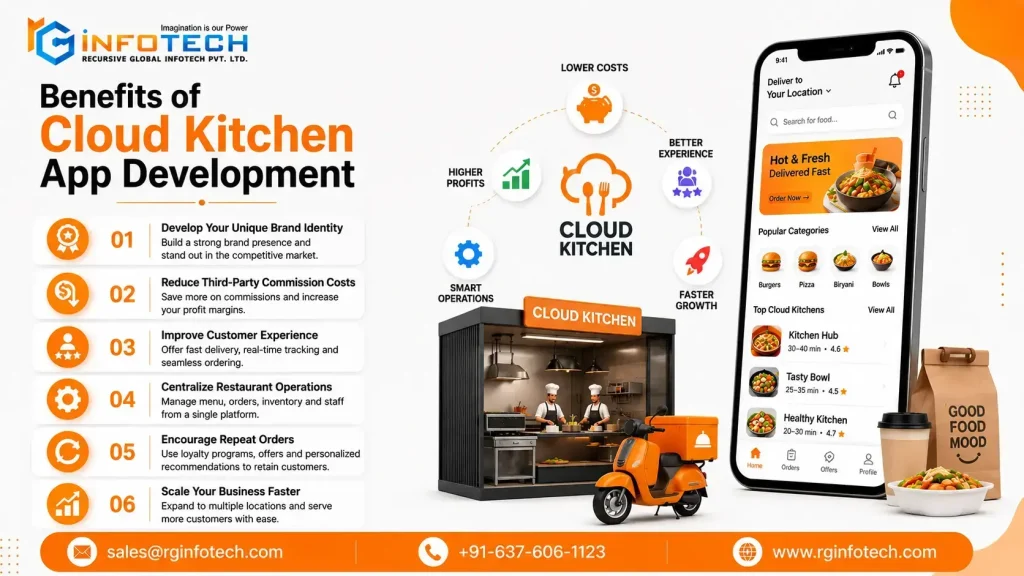
Benefits of Cloud Kitchen Apps

The food delivery business is becoming extremely competitive, and restaurants are not only required to have quality food but also other aspects. A well-developed cloud kitchen application helps businesses
Benefits of cloud kitchen app
If you are operating one virtual kitchen or have multiple brands in different cities, it is recommended that you invest in cloud kitchen app development as it has some business benefits.

1. Develop Your Unique Brand Identity

A custom cloud kitchen application gives opportunity to develop your own brand image with a unique logo, colors, offers, and customized communication with clients.

2. Reduce Third-Party Commission Costs

The major problem that restaurant owners struggle with is the high amount of commissions for each order that goes through food delivery aggregators.

3. Improve Customer Experience

Today’s customers look for fast and convenient services. An excellent user experience results in loyal customers.

4. Centralize Restaurant Operations

The manual process of managing orders from various channels can result in delays and even mistakes. Restaurant cloud kitchen technology will centralize on one platform. Everything will be managed from a single platform.

5. Encourage Repeat Orders

Finding new customers can cost more than keeping existing customers. The cloud kitchen app can help restaurants to repeat orders by providing referrals and a reward program.

6. Scale Your Business Faster

A scalable cloud kitchen platform will help your expansion process become smoother. With time, you can develop the application by adding features and integrations.
If you are investing in food delivery app development, then you should know the benefits in detail. To get this information, check our guide The Real Benefits of Investing in Food Delivery App Development.

Types of Cloud Kitchen Software Business Models

All cloud kitchens do not operate in the same manner. The choice of business model will affect your tech needs, process flow, and capital outlay.
The following are the most prevalent cloud kitchen business models employed by restaurants in 2026.

1. Independent Cloud Kitchen

An independent cloud kitchen works on a single brand and does not have an on-site restaurant. It suits startups, Local restaurants, Local food businesses and Entrepreneurs venturing into the food delivery sector.
Pros:
  • Low capital requirements
  • Simplicity
  • Quick start
  • Inventory management

2. Multi-Brand Cloud Kitchen

One kitchen cooks food for several brands of restaurants, catering to different cuisines or customer profiles. Such as Pizza Brand, Burger Brand, Healthy Food Brand & Asian Cuisine Brand.
Pros:
  • Greater earning capacity
  • Increased efficiency in the kitchen
  • Reduced cost of operations
  • Increased customer base

3. Aggregator-Managed Cloud Kitchen

There are some food delivery companies that create kitchen spaces that can be leased by restaurants while leveraging their logistical and delivery infrastructures.
This business format works for firms that want to grow rapidly without making significant infrastructure investments.

4. Kitchen-as-a-Service (KaaS)

Kitchen-as-a-Service suppliers rent fully furnished commercial kitchen spaces to restaurants. Restaurants just have to concentrate on cooking, marketing, and customer service. All other infrastructure services are handled by the supplier.

5. Hybrid Restaurant Model

Several existing restaurants have started to offer both dine-in and cloud kitchen options. The advantages of such a concept include:
  • Extra sources of income
  • Effective use of the kitchen
  • Delivery expansion
  • Increased business resilience
This type of restaurant is more and more common for well-known restaurant brands.

Essential Features for Cloud Kitchen Management System

A successful cloud kitchen management system needs something more than just an application for customers to place their orders. Cloud kitchens rely a great deal on placing orders through an online platform. The platform needs to cover all areas related to order management.
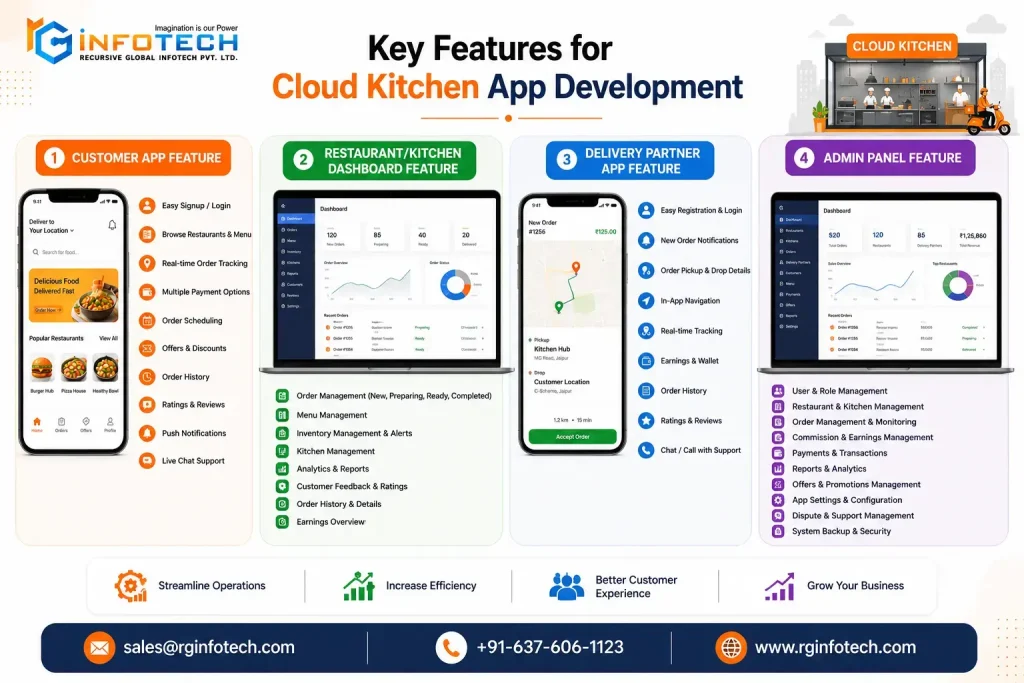
Four cloud kitchen app features play a key role in the success of the app, which are mentioned below in detail.
Features for cloud kitchen app

Customer app

The customer app is the main digital interface through which the cloud kitchen can interact with its customers. It must make it easy to discover food, place orders, pay for them, and track their deliveries.

Restaurant/kitchen Dashboard

The restaurant or kitchen dashboard forms the heart of the cloud kitchen platform, wherein the kitchen staff as well as restaurant management can control orders, menus, workflow, stock, and operations from a single window.

Delivery partner app

If there are cloud kitchens that handle their own delivery process, they would require a separate delivery partner app to be able to link up with the delivery guys.
This would enable the delivery partners to be updated with all their delivery activity through the app.

Admin panel

The admin panel is the platform that controls the entire cloud kitchen setup. It enables the business owner and administrator to manage customers, kitchens, orders, payments, deliveries, marketing, and analytics.

AI Features for Cloud Kitchens

Artificial intelligence is becoming relevant to restaurant management systems as it helps enterprises to manage their data, customers, menus, stock, deliveries, and kitchen activities smoothly.
The AI-enabled food delivery app development, addresses specific problems, including growing order repeatability, minimizing food waste, improving efficiency, or decreasing customer support costs.
The following are the most helpful AI features to implement in the cloud kitchen app.

AI-Powered Food Recommendations

AI recommendation engines can learn from customer behavior and provide specific food recommendations for users.
In case one user often purchases burgers and side dishes during weekends, the application could provide food recommendations for the next visit.

AI-Based Demand Forecasting

Demand forecasting is among the most important uses of AI in cloud kitchens. The AI/machine learning model can examine such trends and assist in predicting future demand.
For instance, the model could predict that certain food items tend to have higher demand at certain times and help the kitchen staff plan for inventory and preparation of such foods.

AI-Influenced Personalized Offers

The cloud kitchen app can take into account client behavior and purchase patterns to offer more customized offers. For instance: An often visiting client could get loyalty incentives.
AI could also be used to classify clients according to their behavioral patterns.

Customer Support Automation

Support services are yet another domain where AI can save people from repeating themselves.
Using the power of AI, an assistant could manage all sorts of customers’ frequently asked questions. For instance, rather than having to manually respond to each “Where is my order?” question, an AI assistant could provide the status of the order and respond accordingly.

Inventory Intelligence

Inventory management can be quite significant for cloud kitchens since the food businesses must strike a balance between availability and waste minimization.
AI can use information on historical consumption, order patterns, menu items’ performance, and inventory to spot patterns.
By combining inventory and orders data, a cloud kitchen can switch to data-based inventory management.

How to Build a Cloud Kitchen App

Cloud Kitchen Management Software is the main interface for food ordering purposes. A good system should be able to link various elements like customers, kitchens, administrators, deliveries, payments, analytics, and even AI-based cloud kitchen automation.
The process of developing the application must start with the understanding of your business model and needs.
This is the cloud kitchen app development process we follow.

Step 1: Define Your Cloud Kitchen Business Model

Prior to embarking on the development of your cloud kitchen business, be clear about how it is going to work. The type of your business is going to define which features are required for the development of your application.
For example, a cloud kitchen with a single brand is going to require a customer app, a kitchen dashboard, payments integration, and an admin panel. A multi-brand or multi-location cloud kitchen is going to require all of those as well as some others.

Step 2: Research Your Target Market and Competitors

After the business model is determined, conduct market research to study your prospective customers and their existing competition.
Market research will help you find areas of need that your cloud kitchen software application can fill.

Step 3: Plan the MVP & Feature List

The next stage is the identification of the key features for your MVP. Some of the possible user interfaces in your app for a cloud kitchen are:
  • Customer application
  • Dashboard of the restaurant/kitchen
  • Delivery partner application
  • Administrator panel
The list of MVP features should be restricted to those which are vital for order receiving and fulfillment.

Step 4: Design the UI/UX

The user interface should be simple and understandable to use. The design of the kitchen interface should be such that the kitchen staff can easily know the newly placed orders, what needs to be done first, and the status of the orders.
In the same manner, the delivery partner should have an easy-to-use interface that provides him information about the order, navigation, and status of delivery.
The customer journey should be:
Open App → Browse Menu → Select Food → Customize → Add to Cart → Checkout → Pay → Track Order
Also, the design should be responsive, accessible, and consistent across supported devices and platforms

Step 5: Choose the Technology Stack

Choosing the appropriate technology stack forms an integral part of developing a cloud kitchen application. There is no specific technology stack that works well for all cloud kitchens. The ultimate choice must be made on the basis of the project requirements.

Step 6: Development & Integration

After the UI/UX and technical architecture have been determined, the actual development phase takes place. The development of the platform through modules helps in easy testing, maintenance, and scalability as the company grows.

Step 7: Testing

Prior to deploying the cloud kitchen app, every critical element must be tested properly. Proper testing helps in discovering any issues that may arise later on from customers’ and the kitchen’s perspectives.

Step 8: Launch and Marketing

Following development and testing, the app for the cloud kitchen would be ready for launch. The best approach would be to blend product quality, retention of customers, organic visibility, and customer acquisition, rather than focusing on just one marketing channel.

How to Monetize from Cloud Kitchen App Development

The revenue generation process can be carried out by a variety of methods in the case of a cloud kitchen app, depending on the type of cloud kitchen you run, the number of virtual brands, or whether you are creating a technology platform for restaurants.
If you want to know in detail how food delivery management can increase your revenue, then check our guide – Food Delivery App Development Services to Boost Revenue in 2026.
You must pick the best monetization method, as it has to match your target audience, the number of orders, operational expenses, and your business goals.
Let’s look at some popular cloud kitchen app monetization methods.

1. Commission on Orders

A commission-based model allows the platform to earn a percentage from every order placed through the application.
For example, if a customer places a $30 order and the platform charges a 10% commission, the platform earns $3 from that transaction.
This model can work well for multi-vendor cloud kitchen platforms where multiple restaurants or virtual brands receive orders through the same application.

2. Delivery Fees

Delivery fees can help generate extra revenue for businesses. For instance, customers can be offered free deliveries when their orders exceed a particular threshold, while lower orders can attract delivery fees.
However, companies have to exercise caution when charging delivery fees so that they do not hurt sales and customer loyalty.

3. Subscription or Membership Plans

This kind of strategy can provide continuous income along with other advantages to consumers.
For instance, a consumer who often orders meals would like to pay a monthly membership fee in exchange for getting lower fees on deliveries.
In addition, such a plan is helpful in increasing the retention rate of customers.

5. Advertisement

An application that has a large number of users can create other sources of income in the form of advertisements.
As the platform gains popularity, advertisements become an even more valuable source of income.
However, ads must not disturb the ordering process.

6. AI-enabled Premium Features

The capabilities of artificial intelligence can be another source of revenue for cloud kitchens software vendors.
For instance, if a restaurant uses the basic plan from the platform, they might pay extra to use the premium plan, which includes demand forecasting and AI-generated business insights.
The AI capability needs to offer actual business value, not just serve as a premium feature.
If you are thinking of developing your own cloud kitchen application, the monetization model needs to be taken into account right at the planning stage since otherwise the application itself will be developed without taking into account the future monetization process.

Latest Trends For Cloud Kitchen Software Development

Cloud kitchen business is becoming technology-centric. In 2026, restaurant owners do not settle with just basic ordering and delivery services; rather, they are working on advanced features including AI integration, automation, real-time analytics, an interconnected kitchen management system, personalization, and direct relationship with customers.
This will allow you to build an efficient cloud kitchen application by analyzing the market trends. Here are some of the latest cloud kitchen technologies.

1. AI-Based Cloud Kitchen Operations

The implementation of artificial intelligence technology is changing from being an experiment to becoming a practical solution for restaurant operations.
AI can be used in cloud kitchens to study order history, customer habits, inventories, deliveries, and kitchen operations.

2. Hyperlocal Cloud Kitchens and Fast Delivery

More and more customers are demanding fast delivery of their meals, especially in crowded urban centers.
This trend is driving cloud kitchen entrepreneurs to set up smaller kitchens that are located near consumers.

3. Multi-Brand Cloud Kitchen Platforms

The multi-brand cloud kitchen platform is still one of the significant types of cloud kitchens being utilized.
Multiple brands use a single kitchen for catering to diverse customers.

4. First-Party Ordering and Customer Information

Cloud kitchens are now exploring means through which they could connect directly with their customers and avoid third-party marketplaces.
The use of an app or website branded with the company’s name would enable such connection.

5. AI-Powered Personalization

Personalization is gaining importance in food ordering applications.
Unlike the traditional method, where the same menu and offers are shown to all customers, AI can analyze the behavior of each user and generate relevant offers.
The app could offer:
Previous Orders → User Behavior → Relevant Offers → Personalized Offers
The most effective approach would be to develop a scalable core infrastructure initially, and then gradually implement AI, automation, analytics, and many other features with the company’s growth.

Why Choose RG Infotech for Custom Cloud Kitchen App Development?

As a best cloud kitchen app development company, RG Infotech specializes in providing services in the areas of web application and mobile application development. The firm has over 15 years of experience and has delivered over 1,500 projects and satisfied over 1,250 clients in over 70 countries.
For custom cloud kitchen software development, we provide the services mentioned below in our app, and it can be customized to meet the restaurant owner’s requirements.
  • Custom cloud kitchen mobile app development
  • AI integration
  • Customer applications
  • Restaurant panels
  • Delivery partner applications
  • Admin dashboards
  • Real-time order tracking
  • Payment integrations
  • GPS navigation
  • Menu and pricing management
  • Order management
  • Analytics
  • Inventory integration
  • Multi-language & currency support
Technology is also listed by the company within mobile, front end, back end, databases, cloud computing, DevOps, and design. This means that the technology stack can be chosen based on project needs rather than having every business follow the same architecture.

Conclusion

Cloud kitchen software development in 2026 is not only about building an app to facilitate food ordering.
The best platforms integrate the whole ecosystem:
Customer -> Order -> Kitchen -> Inventory -> Delivery -> Analytics
When it comes to a small cafe, its initial focus might be on building an MVP with order and payment processing, kitchen control, and delivery logistics.
As for a growing food company, its roadmap might involve multi-location management, inventory, analytics, loyalty, restaurant POS integration, and automation.
For an enterprise or a food-tech startup, the platform might eventually require a multi-brand architecture, advanced analytics and AI capabilities, integrations, and scalable architecture.
And, thus, the most important question is not just “How much would it cost for a cloud kitchen app?”
But it is: “What technology architecture and feature set will support my business model today while allowing the platform to scale tomorrow?”
When you plan to develop a custom cloud kitchen app, collaboration with the right cloud kitchen app development company can help you translate your business needs into a scalable product roadmap.
Build a Custom Cloud Kitchen Application with RG Infotech

We assist companies in building custom mobile and web-based solutions for food delivery and cloud kitchen management. If you are creating a new cloud kitchen or extending your restaurant chain, the entire process of application development can be customized according to your business model, target audience, functionalities, and future expansion. Contact us to discuss custom cloud kitchen app development services and receive a customized estimate for your project.

Frequently Asked Questions

The cloud kitchen app development cost varies according to several criteria: the number of functionalities, the platform and operating systems, additional integration services, design intricacy, the number of apps, and scalability requirements. For example, according to RG Infotech, which publishes its prices online, the prices of a basic MVP can be anywhere between $5,000 and $15,000, a mid-level app – $20,000 and $40,000, and an advanced platform – $50,000 and $100,000+.

It will take about 6-8 weeks to build a food delivery app, 3-4 months for a mid-level app, and 5-7 months for the development of a fully-fledged platform.

Yes. A custom platform can be designed to manage multiple virtual brands from one kitchen infrastructure, with separate menus, pricing, analytics, and brand-level administration.

Yes. There is a possibility of AI integration in applications for recommendations, customer management, demand forecasting, support automation, inventory intelligence, and many other applications where there is enough data and a definite business goal.

Yes. The payment gateway integration is based on the target market and business needs. RG Infotech currently supports integration with payment gateways like Stripe, Razorpay, and PayPal.

There is no one-size-fits-all approach when it comes to selecting a technology stack. It completely depends upon various factors like platform, scalability, integrations, performance, and development budget, among others. Flutter, React Native, Node.js, Laravel, Python & Django, MySQL, MongoDB, PostgreSQL, AWS, and Azure are some examples of such technologies.

Yes. Real-time order tracking can be achieved through the use of location services and maps. RG Infotech presently mentions real-time GPS tracking as a feature of its food delivery application capabilities.

You need to go for custom app development when you have a need for unique workflows, advanced integrations, multibranding, AI, etc. White labeling could suit your needs in case of a need for quick development.

Written By :

RG Infotech

RG Infotech is an IT development company specializing in on-demand solutions, web and mobile app development, game development, and website development. Their skilled teams of UI/UX designers, gaming industry experts, and developers proficient in React.js, Angular, and Node.js deliver custom software solutions globally across diverse industries. RG Infotech leverages latest technologies like AI and AR/VR, particularly for development, to provide high-quality solutions that meet client needs worldwide.

Related Blogs

Request a Best Suited Quote Now!!!

By filling the form and sharing your project goals and contact information.

Forget about the stock proposals. Your business is unique, and so we provide unique solutions and pricing. We would be grateful to be a part of your journey and adding value to your business. Your information would allow our analysts to understand your project and help them to provide a quick and relevant response.

map
Visit us

1st floor, Krishna Tower, Dhawas Road, 200ft Bypass, Ajmer Road, Jaipur, India - 302024

Get Directions

map
Contact us
+91-6376061123

    captcha