Top 5 Must-Have Features for Food Delivery App Development

banner
October 6, 2026 On-Demand Solution

Summary:

In this blog, we have described the 5 top must-have features that a food delivery app should be developed with, such as a smooth ordering process, a secure payment process, a tracking feature, restaurant management, and more. Find out how these features make the food delivery app development successful.

Food Delivery App Development has converted online ordering of food into an ecosystem facilitated by technology in which customers, restaurants, couriers, and administrators interact.
In today’s competitive environment, simply providing food ordering services is not enough. The success of a food delivery portal lies in the presence of certain attributes that ease food ordering, payments, delivery, and restaurant operations.

Key Takeaways:

Online food delivery revenue is projected to approach $1.4 trillion globally in 2025.

India’s online food delivery market is projected to reach ₹5.72 trillion in 2026.

Mobile applications accounted for approximately 79% of India’s online food delivery market in 2025.

Global food delivery app downloads increased 40% year over year in the first three quarters of 2025, while India recorded 147% year-over-year growth in downloads during H1 2025.

Whatever your purpose – be it starting a food delivery company, growing your current restaurant business, or establishing a multi-vendor food delivery app – selecting the appropriate features while developing a food delivery app is important.
Below, we will examine the 5 essential food delivery app development features and learn about other food delivery app features.

Launch Your Food Delivery App Through RG Infotech

Are you aiming to create an efficient food delivery application that can cater to customers, restaurants, and delivery partners? RG Infotech offers complete food delivery application development services based on your needs.

Talk to our experts about your food delivery application ideas now.

What Are the Must-Have Features for a Food Delivery App?

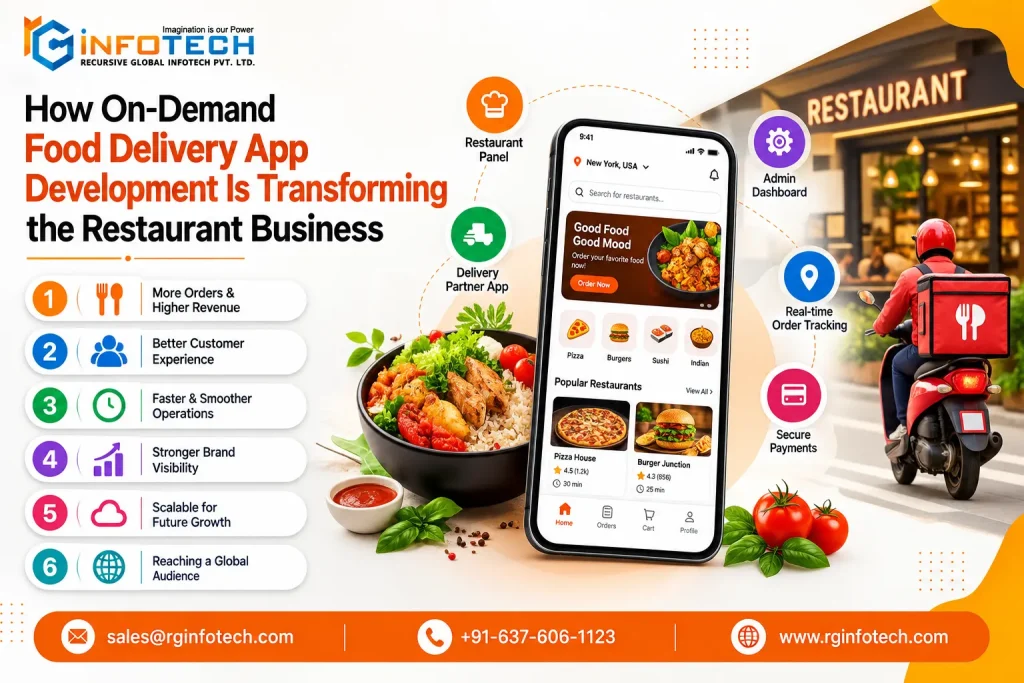
A food delivery system is generally made up of several applications or interfaces, like the consumer interface, restaurant interface, delivery partner application, and administration panel.
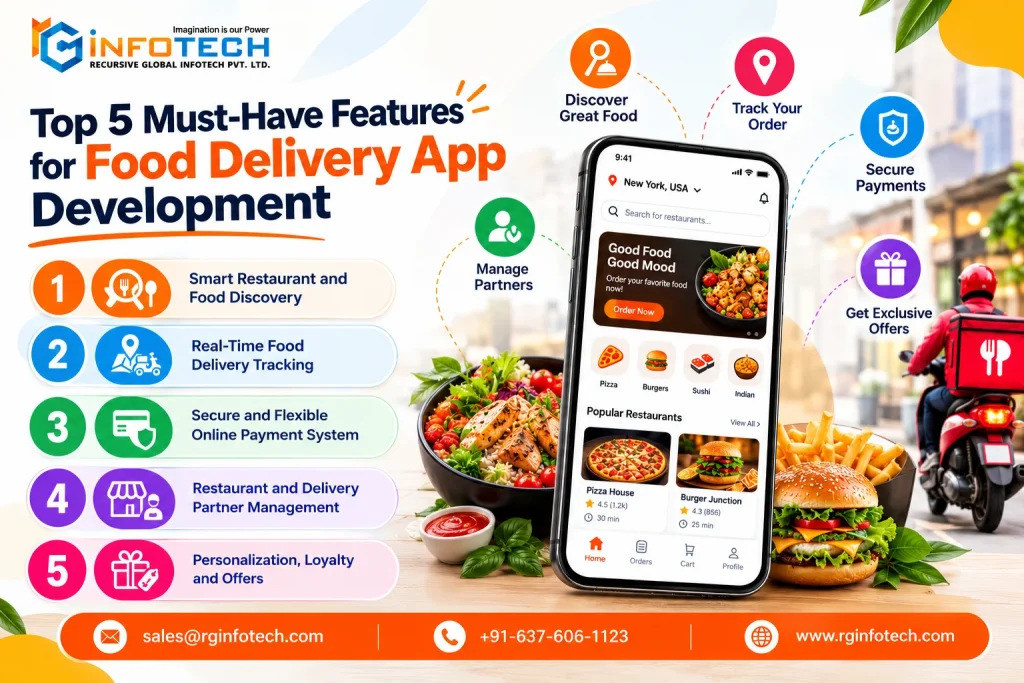
The five basic food delivery app development features are
Feature

Customer

Restaurant

Delivery Partner

Business Benefit

Smart food & restaurant discovery

✓

✓

—

Easier product discovery

Real-time order tracking

✓

✓

✓

Better delivery transparency
Secure payment system

✓

✓

—

Convenient checkout
Restaurant & delivery management

✓

✓

✓

Efficient operations
Personalization, offers & loyalty

✓

✓

—

Better customer engagement

We will now look into these aspects in greater depth.

Top 5 Must-Have Features for Food Delivery App Development

Get to know the five key elements in developing a food delivery app, such as the discovery of restaurants, ordering, payment, tracking, management of restaurants and deliveries, as well as personalized recommendations that can improve your users’ experience and facilitate the development of your business.
Food Delivery app development

1. Smart Restaurant and Food Discovery

Finding the correct restaurant or food is the primary requirement for this restaurant search and discovery is an essential food delivery app feature.
A traditional food delivery app displays restaurants in the form of a simple list, whereas new-generation platforms have different ways for users to discover their required food through preferences and locations.

Essential discovery features

An application for food delivery may have the following discoverability aspects:
  • Search for restaurants and their food menu
  • Filters by cuisine
  • Restaurant discoverability through location
  • Filters by price
  • Ratings and reviews
  • Estimated delivery time
  • Filters by vegetarian and diets
  • Popular dishes
  • Restaurant availability
  • Personal recommendations
  • Favourite restaurants
  • Recently ordered dishes
For instance, when a customer searches for “nearby Indian food,” he must not browse hundreds of results but instead filter restaurants according to delivery time, ratings, price, and distance.

Why smart discovery matters

The easier the process of finding something becomes, the fewer actions customers need to do before they place their orders.
On the level of development, this feature may include search capabilities, location-based features, filter algorithms, information about restaurants, menus, ratings, availability, and recommendation engine
For MVP, basic search and filters can suffice. In more advanced systems, personalization may be added later based on customers’ behavior and ordering experience.

2. Real-Time Food Delivery Tracking

After the order has been made, the customer wants to know what happens next.
In this case, real-time tracking becomes one of the most crucial aspects of any contemporary application for food deliveries.
The process flow can be described as follows:
Order Made → Restaurant Confirmed → Food Being Prepared → Picked Up → Delivery On Its Way → Delivered
The application must make the customer aware of each stage.
Tracking features that matter
A delivery tracking system can have:
  • Real-time delivery partner’s location
  • GPS tracker
  • Update about order
  • Time for delivery
  • Preparation status of food at restaurant
  • Push notifications
  • Navigation for the delivery partner
  • Communication between customer and driver
  • Confirmation for order delivery
For instance, instead of just “Your order is on the way,” it could show the location and time of delivery partner.

What happens behind the scenes?

For real-time tracking, the following interaction needs to take place among different components:

Customer App → Backend → Delivery Partner App → GPS/Maps → Customer App

Location data from the delivery partner’s app is sent to the backend, and updates are received by the customer app.
While developing food delivery apps, developers need to keep network connection, location precision, battery usage, update rate, and scalability in mind.

Thus, real-time tracking goes beyond map integration and becomes an essential part of the application architecture.

3. Secure and Flexible Online Payment System

The smoothness of the checkout process will have an impact on the overall ordering process of the user.
The food delivery application should enable easy payment mechanisms while dealing with the issues of successful transactions, unsuccessful transactions, refunds, and order confirmation.
Some of the payment methods that might be incorporated in such apps could include the following:
  • Credit and Debit Cards
  • UPI
  • Digital Wallets
  • Net Banking
  • Cash On Delivery
  • Saved Payment Methods
  • Discounts
  • Gift cards/credits
UPI may be an essential payment method especially for applications that target users from India.

Core payment functionalities

Apart from the modes of payments, there should also be considerations of:
  • Payment gateways
  • Transaction verification
  • Recovery of failed payments
  • Processing of refund
  • Payment receipt
  • Invoice
  • Transaction history
  • Payment information security
Moreover, the process of making payment must be such that an incomplete transaction does not cause creation of duplicate orders and duplicate payments by mistake.
Security should always be a fundamental aspect of development and not just an extra element.

4. Restaurant and Delivery Partner Management

Food delivery platform is not just a customer application.
In fact, there are other players like restaurants, delivery personnel, and administration that have to play their roles within the order process.
Here is where a good food delivery platform can differ from an ordinary food-ordering application.

Restaurant panel

Some of the features restaurants might need could be:
  • Management of restaurant profiles
  • Management of menus
  • Food availability
  • Pricing management
  • Order acceptance/decline
  • Status of order preparation
  • Working hours
  • Offers and discounts
  • Customer feedback
  • Order history
  • Sales info
As an example, if a restaurant is out of a certain dish, it should be possible for the restaurant staff to make this dish unavailable without contacting the administrator.
Delivery partner application
The delivery partner can ask for:
  • Registration and verification
  • Availability of orders
  • Acceptance of order delivery request
  • Pickup details
  • Customer’s location
  • Navigation
  • Update onf delivery status
  • Details about earnings
  • Delivery history
  • Support features
The delivery partner process should be simple because the driver will use the application while traveling from pickup to delivery locations.

Admin dashboard 

The admin generally requires a bigger picture of the platform such as:
  • Customer management 
  • Restaurant management 
  • Delivery partner management 
  • Order management 
  • Payment management 
  • Commission management 
  • Coupon management 
  • Content management 
  • Reports & Analytics
  • Support management

Multi-sided architecture is an important aspect to consider while developing food delivery apps.

5. Personalization, Loyalty and Offers

Acquiring customers to make their first-order is just the first step in creating a sustainable food delivery platform.
In addition to that, the application should offer some facilities for the customers to make more orders.
Personalization features
  • Based on the maturity level of the platform, personalization can incorporate:
  • Recommendations for restaurants
  • Recommendations for dishes
  • Recently ordered food items
  • Favorite restaurants
  • Personalized search
  • Recommendations based on location
  • Recommendation for meal based on previous orders

For instance, if the user often orders pizza from a certain restaurant, then the app can suggest such restaurant and similar dishes.

Loyalty and promotions

In addition, a food delivery app can have:

  • Coupon codes
  • Discounts for first-time orders
  • Loyalty points
  • Referral rewards
  • Restaurant-based offers
  • Free delivery deals
  • Membership plans
  • Personalized deals
  • Promotional alerts
The above-listed features need to be well-designed, as promotions should be kept feasible for the restaurants as well as the platform.

Additional Features to Consider in Food Delivery App Development

The five features listed above are great to start with, but other functionalities might be needed if it were a bigger delivery platform.

  • Features for MVP
  • When creating an MVP, one could take into consideration:
  • User registration and login
  • Restaurant searching
  • Browsing the menu
  • Search and filter
  • Cart
  • Checkout
  • Online payment
  • Order management
  • Order tracking
  • Push notifications
  • Restaurant dashboard
  • Partner application for delivery
  • Admin panel

Advanced features

As the platform matures, advanced features might be as follows:

  • AI-based recommendations
  • Voice command food ordering
  • Prediction of delivery times
  • Advanced analytics
  • Dynamic delivery charges
  • Subscription offerings
  • Loyalty programs
  • Multi-order delivery optimization
  • Automated customer service
  • Advanced restaurant analytics
The list of appropriate features depends on many factors including business model, target market, budget, and geography.

How Does a Food Delivery App Development Work?

An example of the food ordering application would involve four main parties:

Customer → Restaurant → Delivery Partner → Admin

The general procedure involves the following steps:

  • The customer finds a restaurant or food product to buy.
  • The customer selects the foods and puts them in their basket.
  • The customer inputs or selects their delivery location.
  • The customer pays for the goods or selects the available payment option.
  • The restaurant receives the order.
  • The restaurant accepts the order and prepares the products.
  • The delivery partner gets the delivery request.
  • The delivery partner picks up the order.
  • The customer follows the order during delivery.
  • The delivery partner delivers the order.
  • The customer gives the rating/review for the delivered product or service.
This sequence of events should be taken into account when designing the application.

How Much Does Food Delivery App Development Cost?

The price for food delivery app development varies between $20,000 and $150,000+ depending on various factors such as the complexity of app’s functionality, platform count, integrations, technology stack used, and a development team. 
An MVP with basic ordering capabilities would cost a lot less than a marketplace operating across several cities.
For instance, a simple food delivery MVP will cost about $20,000-$40,000, while a full-fledged marketplace is expected to cost you somewhere between $50,000 and $100,000 and more. A massive, multi-city scale platform with advanced logistics, AI-driven personalization and analytics and high-performance infrastructure can cost over $150,000.

As each food delivery platform has its unique needs, businesses are recommended to clarify feature list, platforms and integration needed, and technical stack prior to estimating the cost of development.

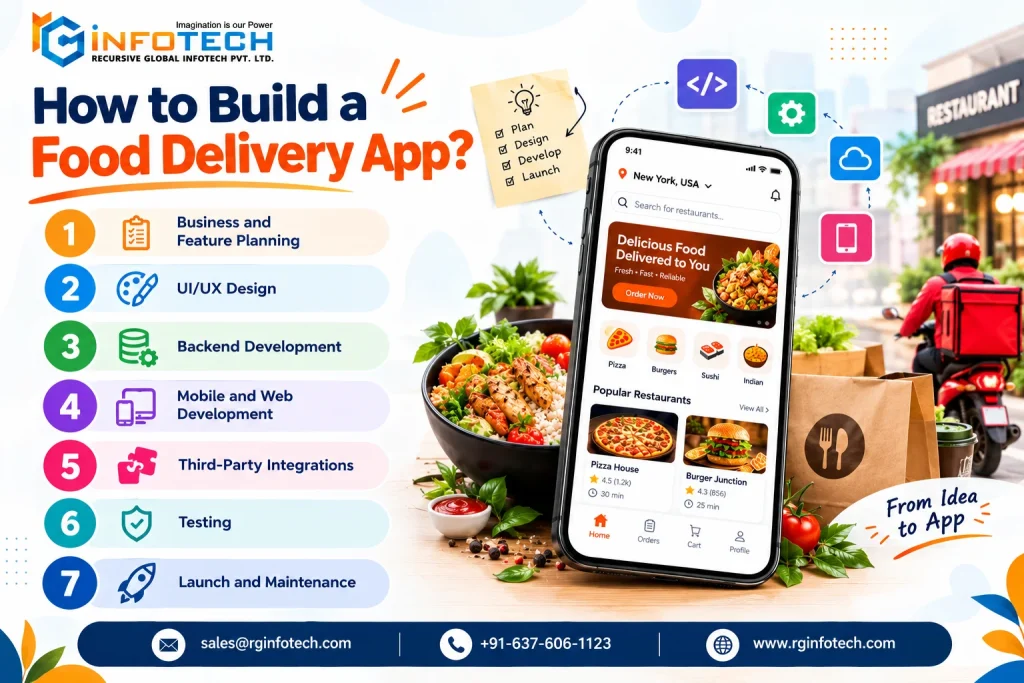
How to Build a Food Delivery App?

In order to build a functional food delivery app, more is needed than just building the interface of the app. The other components include customer ordering module, restaurant management module, delivery module, payment module, tracking and administration modules.

The food delivery app development process involves the following steps:

1. Business and Feature Planning

It is important to begin by setting the business and technical requirements prior to development. Some factors to be considered include:

  • Target customers or users
  • Business model
  • Cities to target
  • Applications or platforms needed
  • Key MVP functions
  • Additional functions for future releases
  • Requirements of restaurants and delivery partners
  • Monetization strategy

Setting the MVP will help in containing the scope of the development process while leaving room for future advanced functionality additions.

2. UI/UX Design

The platform should deliver unique experiences to each kind of user depending on the business model:

  • Customer mobile app
  • Restaurant mobile app or dashboard
  • Delivery partner mobile app
  • Admin dashboard
The design should favor ease of navigation and reduce the steps needed to complete crucial tasks like searching for food, placing orders, receiving deliveries, or managing restaurants.

3. Backend Development

The backend serves as the backbone of the food delivery platform and links the various applications and services
A scalable backend design is critical especially for platforms that are expected to host multiple restaurants, delivery partners, locations, and orders at once.

4. Mobile and Web Development

Based on the business requirements, development may include:
  • Customer mobile app for iOS and Android
  • Restaurant application or web dashboard
  • Delivery partner mobile app
  • Admin web panel
Businesses should determine whether they need native applications, cross-platform development, or a combination of mobile and web applications before development begins.

5. Third-Party Integrations

A food delivery service is likely to depend on the use of a variety of external applications and APIs, including:
  • Payment gateways
  • Navigation services
  • GPS services
  • Push notification services
  • SMS and email services
  • Analytic platforms
  • Cloud services
  • Customer support systems
The number of integration may have a huge impact on the cost of developing an application for food delivery.

6. Testing

Prior to deployment, the application must be thoroughly tested for any problems related to functionality, performance, security, and usability.

Test activities may consist of:

  • Functional test
  • Payment and transactions tests
  • API tests
  • Security tests
  • Performance and load tests
  • GPS and location tests
  • Device and browser compatibility tests
  • Notification tests
  • User acceptance tests

The order process, from restaurant search and checkout, payment, assignment of delivery personnel, and tracking until completion of an order, must be tested.

7. Launch and Maintenance

After launch, the platform needs ongoing monitoring, bug fixes, security updates, performance optimization, and feature improvements based on user feedback. To get this process in detail, check our blog on the food delivery app development process.

Technology Stack for Food Delivery App Development

The technology stack relies on the requirements of the project and the technical skills of the developers

A modern platform may use:

Layer

Possible Technologies

Mobile App

Flutter, React Native, Swift, Kotlin

Backend

Node.js, Java, Python, PHP

Database

PostgreSQL, MySQL, MongoDB

APIs

REST APIs, GraphQL

Cloud

AWS, Google Cloud, Microsoft Azure

Maps

Google Maps or other mapping services

Notifications

Firebase Cloud Messaging or equivalent services

Payments

Regional payment gateway integrations

There is not one specific technology stack that can be called an optimal option for every company working in the field of food deliveries.
Looking to Develop Your Food Delivery App?

Transform your food delivery concept into a fully featured and scalable app through RG Infotech. Right from design of UI/UX and development of MVP to integrating payments and real-time tracking, we will develop your food delivery app.

Let us be your partner for developing your food delivery app!

How to Choose the Right Features for Your Food Delivery App

Selection of appropriate features in a food delivery application depends on a variety of factors such as your target audience, business model, geographical location of the business, and future growth prospects. Rather than integrating all possible features, companies must select those features that help improve their customer experience and streamline operations
Some of the aspects that need to be considered in this context are as follows:
  • Essential features for accomplishing the fundamental ordering and delivery process.
  • Enhancing the customer experience and improving efficiency as the application scales up.
  • Features such as advanced personalization, predictions, automation, and logistics.
The process of launching a focused MVP can assist in validating the product even before making any investment in advanced features.

Conclusion

Development of an effective food delivery app is not merely the integration of a food menu and checkout interface. There must be a system which will tie together all the parties – users, restaurants, delivery service providers, and the administration team.
Five features deserve special consideration:
  1. Smart restaurant and food discovery
  2. Real-time order tracking and delivery tracking 
  3. Secure and flexible payment processing 
  4. Restaurant and delivery service provider management 
  5. Personalization and loyalty features
The optimal set of features will depend on a number of factors.
If you are looking for an efficient way to develop a food delivery app that is feature-packed and scalable, RG Infotech will be happy to assist you with bringing your vision to life.
Specializing in food delivery application development services, RG Infotech offers full-cycle app development solutions according to the needs of any business. Are you looking for a reputable mobile food delivery app development company? Contact us for a discussion about your project needs.

Frequently Asked Questions

These core features are restaurant & food discovery, menu viewing, cart & checkout process, payment, order management, real-time tracking, notification, restaurant management, delivery partner app, and admin dashboard.

Features that one needs in a food delivery partner app are delivery requests, order acceptance, pickup details, navigation, location of customer, delivery updates, earning details, delivery history, and support.

Some of the key features in a restaurant application include the management of menus, item availability, order placement, order status, prices, opening hours, promotions, ratings, order history, and analytics.

Development time for a food delivery app is generally expected between 3 months and 12+ months, based on the complexity of its features and functionality.

  • MVP (basic): 3–5 months
  • Rich feature set app: 6–9 months
  • Enterprise-level app: 9–12+ months

Defining MVP scope and specifying technical requirements will help to speed up the process and prevent delays.

Yes. A multi-vendor food delivery application can facilitate managing of menus and orders for multiple vendors through separate dashboards while having access to them through one application by customers.

Written By :

RG Infotech

RG Infotech is an IT development company specializing in on-demand solutions, web and mobile app development, game development, and website development. Their skilled teams of UI/UX designers, gaming industry experts, and developers proficient in React.js, Angular, and Node.js deliver custom software solutions globally across diverse industries. RG Infotech leverages latest technologies like AI and AR/VR, particularly for development, to provide high-quality solutions that meet client needs worldwide.

Related Blogs

Request a Best Suited Quote Now!!!

By filling the form and sharing your project goals and contact information.

Forget about the stock proposals. Your business is unique, and so we provide unique solutions and pricing. We would be grateful to be a part of your journey and adding value to your business. Your information would allow our analysts to understand your project and help them to provide a quick and relevant response.

map
Visit us

1st floor, Krishna Tower, Dhawas Road, 200ft Bypass, Ajmer Road, Jaipur, India - 302024

Get Directions

map
Contact us
+91-6376061123

    captcha