Summary:
Mental health app development involves a lot of careful consideration regarding planning, technologies used, designing, and compliance. This mental health app development guide will take care of all the things required to develop such an application, including core features and AI implementation, expenses, and selection of the development company.
Mental Health App Development is revolutionizing how people use technology for their psychological well-being.
It helps in mood monitoring, meditation, therapy sessions, and journaling. However, developing an effective application requires more than innovative capabilities.
If you are planning to develop a health app, you need a well-defined strategy, an easy-to-use user experience, strong security, and an understanding of users’ needs.
Key Takeaways:
- 1 in 8 people globally live with a mental disorder, so providing digital solutions gives accessible mental health support to users.
- The global mental health apps market size reached approximately $7.5 billion to $9.94 billion and is projected to expand significantly toward a valuation of over $17 billion to $33 billion by the early 2030s.
- 970 million people were living with a mental disorder globally in 2019, with anxiety and depression among the most common conditions.
- AI chatbots and digital companions are reshaping emotional connection
- More than 10,000 mental health apps have been built all over the world; this shows the growing role of technology in mental health support.
- Security and privacy should be core development priorities for mental health apps.
If you want to learn how to create a mental health app that users will trust and use? Here is all the information you will need, from features of a mental health app to technology, security, regulations, revenue generation models, and the price of developing a mental health app. We have covered it all in our blog.
This blog is going to assist you in getting insights into developing an effective, scalable, secure, and next-gen AI-powered mental health app.
Build a Safe and Secure Mental Health App with RG Infotech
Are you thinking about building an app for mental health management? Work with RG Infotech to convert your thoughts into a safe and scalable digital mental health product. Reach out to our team to receive a personalized solution plan for your project.
What Is Mental Health App Development?
Mental health mobile app development is defined as the practice of conceptualizing, designing, developing, testing, releasing, and maintaining a mobile app that provides support for mental health, mental well-being, behavioral health, or mental health service access.
The approach to development needs to be based on the application purpose. A meditation and mindfulness app will have very different requirements compared to a communication tool for interaction between clinicians and patients.
That is why, first of all, it is important to clearly define what the application is supposed to do and what it is not supposed to do.
Why Develop a Mental Health App?
Digital technologies may help improve access to mental health care. From an organizational perspective, digital healthcare technologies may bring opportunities for user engagement, education, assistance to professionals, and other digital services.
Potential benefits of developing mental health apps are:
Accessibility
Individuals have convenient access to chosen resources through their mobile phones without having to go to a specific location.
Personalization
Applications can be tailored to meet individual needs and preferences based on the usage pattern of the users.
Continuous engagement
Various features like notifications, monitoring progress, journaling, and habits may motivate people to keep interacting with the app.
Support for healthcare professionals
Based on the chosen product model, apps may assist professionals with managing appointments, communicating with patients, and tracking selected data.
Digital services that scale
A software platform may have the capability of being able to reach out to users from various locations without necessarily having every interaction happen at a physical location.
Nevertheless, accessibility does not equate to effectiveness. A digital service must make only such claims that it can support. To get into the details of this, check our guide on Healthcare App Development Benefits in 2026.
Types of Mental Health Apps
Mental health applications can be developed for various purposes, ranging from enhancing everyday wellness and dealing with stress to making it possible to get connected to professionals.
Selecting the proper type of mental health application will become the first crucial step when developing mental health applications, as it will affect many things, including development costs.
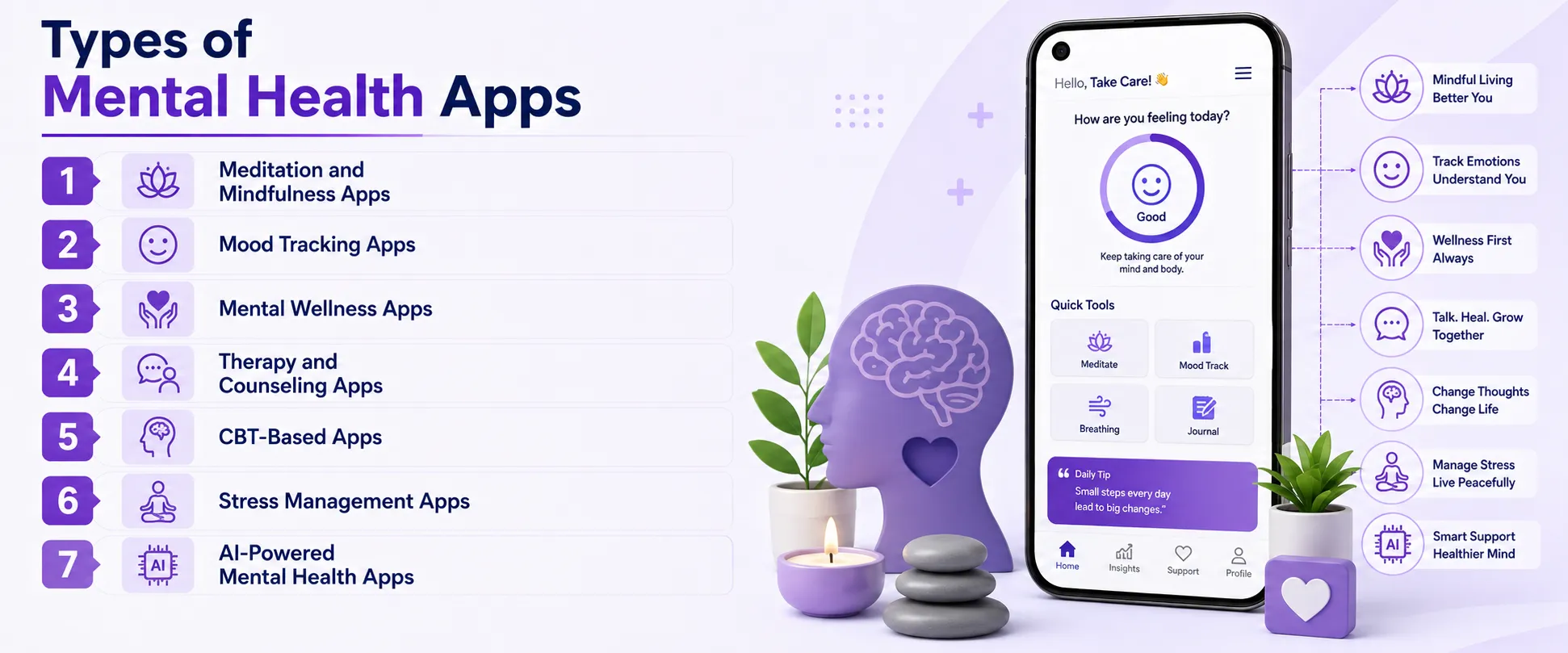
1. Meditation and Mindfulness Apps
Apps for meditation and mindfulness allow individuals to relax, enhance concentration, handle daily stress, and promote mindful practices. Some of their features include guided meditations, breathing exercises, soothing sounds, information on sleeping, and personalized programs.
2. Mood Tracking Apps
Mood tracker apps give users the ability to log their moods as well as identify trends in their moods. Through check-ins, mood diaries, and even visual reports, it is possible for users to have more insights into their habits.
3. Mental Wellness Apps
These applications are designed for overall emotional health care instead of targeting any clinical disorder. They include both techniques and resources that inspire individuals to adopt healthy habits and routines.
4. Therapy and Counseling Apps
The therapy and counseling applications enable users to access the services of mental health professionals via online portals. Based on the application type and the relevant requirements, users can search for the professionals, book an appointment, and have a consultation.
5. CBT-Based Apps
CBT-inspired applications work on the same principles as Cognitive Behavioral Therapy (CBT) in order to give people the ability to analyze their thoughts, feelings, and actions via digital tasks. Such applications may provide people with access to CBT materials engagingly and measurably.
6. Stress Management Apps
Stress management applications are meant for the user to have control over their daily life stressors, relax, and develop better coping mechanisms. Such applications use exercises, content, and personal activities that are available anytime.
7. AI-Powered Mental Health Apps
AI-enabled mental health applications have transformed the way users interact with mental well-being applications by providing them with more personalized, engaging, and accessible experiences. Through AI-enabled interactions and personalized content suggestions, mental health applications can aid users in their interaction with mental well-being resources in an engaging manner.
Essential Mental Health App Features
The right features for mental health applications will make them effective, interesting, and credible. Rather than including all possible features, you should develop applications based on the needs of your users.
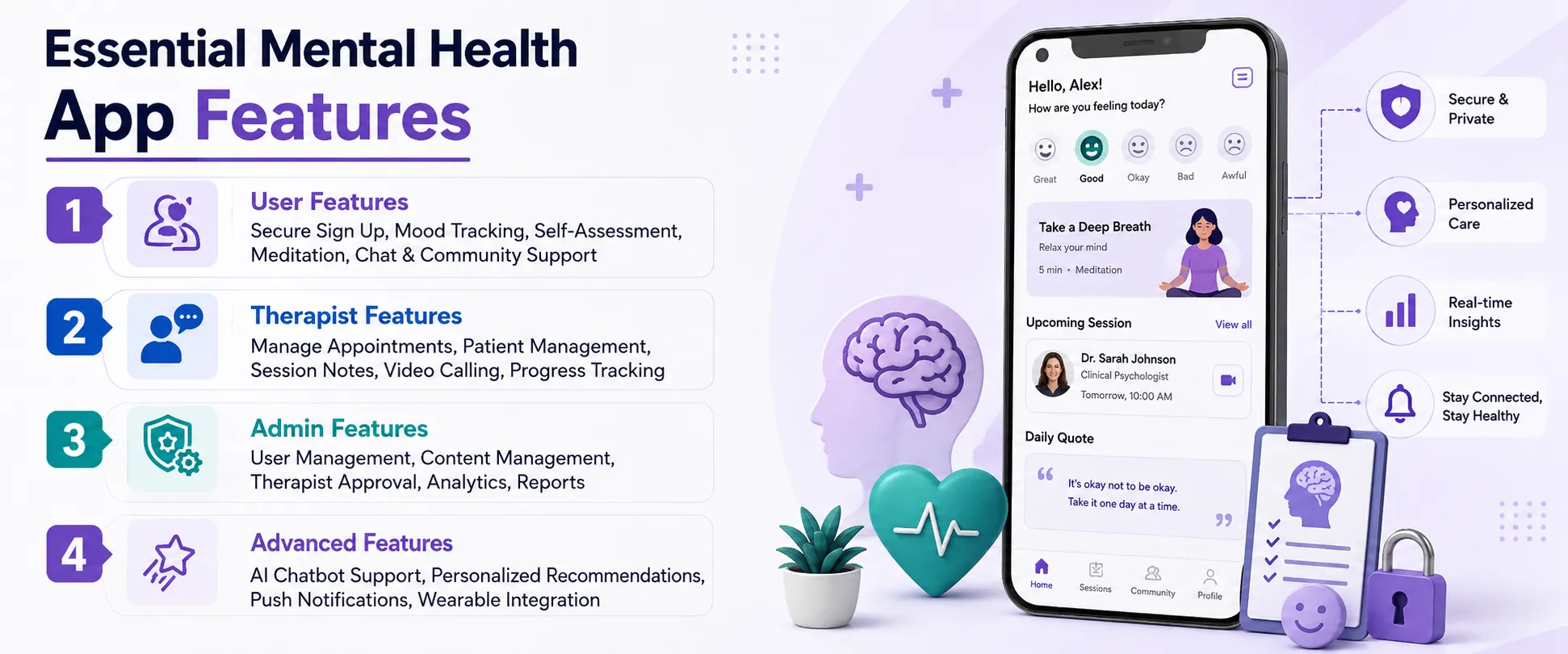
Let’s look at the must-have mental health app features:
User Features
Provide users with an easy and personalized experience by incorporating:
- Quick Sign-up/Login & Onboarding – Fast and secure account creation.
- Mood Logging & Journaling – Log moods, feelings, and journal daily.
- Meditation & Wellness Materials – Listen to guided activities and meditations.
- Relevant Activity Recommendations – Recommend activities according to users’ interests.
- Progress Tracking – Encourage tracking of user goals and activity.
- Customizable Push Notifications – Send notifications that will help users.
- Privacy Controls – Allow users to control their personal information.
Therapist Features
The therapist features can be implemented in order for therapists to schedule appointments and interact with clients.
- Therapist Profiles & Authentication: Feature to showcase professionals’ information and facilitate appropriate authentication.
- Appointment Scheduling: Users should be able to select available slots for making appointments.
- Secure Chat: Feature for proper communication with users.
- Video Chatting: Feature for video chatting as per the use case of the platform.
- Calendaring: Feature that will assist therapists in managing their appointments and availability.
- Clients and Sessions Management: Client interaction management feature and other session-related features.
- Payments: Feature for consultation payment management.
Admin Features
The admin dashboard provides the means for managing users, content, therapists, and platform functionality.
- User & Therapist Management: Managing accounts, profiles, access rights, and the verification process.
- Content Management: Creating, updating, and managing articles, videos, audio files, exercises, and other material.
- Appointment & Transaction Management: Managing scheduling and transactional processes.
- Notifications Management: Managing notifications and communications on the platform.
- Moderation Features: Dealing with any reports and moderating interactions, if needed.
- Role-based Access: Ensuring that admins have access to the information necessary to their function.
Advanced Features
When the core product has been established, enhanced functionalities will increase the personalization and competitiveness of a mental health application.
- AI Personalization: Personalized mental health helps in suggesting activities based on the relevant user information and preferences.
- AI Chatbot: Create an interactive interface for finding new content or supporting general well-being within set limitations.
- Text Sentiment Analysis: Perform text analysis on the basis of appropriate user consent.
- Device Integration: Integrate wearable devices for relevant wellness and activity functionalities.
- Wellness Plan Creation: Generate routines according to user needs and preferences.
- Video Telehealth Integration: Incorporate video telemedicine services, scheduling, and communication capabilities when needed.
- Multi-language/voice capabilities: Make the application more accessible and convenient for users.
The aim of designing a mental health application is not to stuff the product with numerous features. The focus should be on designing features that address the needs of the users. Begin with designing an MVP and then extend the product according to user feedback.
How Much Does Mental Health App Development Cost?
The price for the development of a mental health application will depend on the features of the app, its complexity, platforms, integrations, security, and the development team.
An MVP will be cheaper to develop than a highly-featured app that uses AI, teletherapy, video consultations, and healthcare integration.
App Type
Typical Features
Estimated Cost
Basic MVP
Registration, mood tracking, journaling, content library
$15,000–$30,000
Mid-Level App
Subscriptions, analytics, notifications, advanced profiles
$30,000–$60,000
Advanced App
AI, video consultation, payments, integrations, dashboards
$60,000–$120,000+
In order to get a precise estimate, you need to first determine the MVP features, target platforms, integration and compliance requirements.
Security and Privacy in Therapy App Development
Mental health app security must be viewed as an essential component of the product rather than a nice-to-have one.
Mental health information is highly sensitive, so organizations should ensure that the proper controls are designed from the very beginning of architecture design.
Some of the most important components are:
Encryption:
Ensure proper encryption for in-transit and at-rest data depending on the application’s architecture.
Authentication & Data Minimization: Ensure strong authentication and protection of the account recovery process. Collect information that is required for the product.
Authorization: Access to information must be restricted to what is required for the job of the users/administrator.
Secure API: The APIs must be created in a manner to ensure there are no vulnerabilities that can lead to any kind of data leakage.
Audit Logging & Secure Storage:
Logs must be maintained for sensitive tasks. Do not store sensitive information unless necessary.
Compliance Considerations for Mental Health Apps
Mental health app compliance is based on the functionality of the application, user base, business model, geography, data flow, and legal obligations.
For instance, an application dealing in healthcare operations in the U.S. might have to take into account HIPAA, provided that it deals with protected health information in a covered context.
An application catering to European users will require consideration of GDPR among others.
- HIPAA: Can apply to certain health care entities and business dealings within the United States, particularly where there is protected health information.
- GDPR: Applicable where an application uses personal information from individuals who are residents of the European Economic Area.
- Health Data Privacy: Needs to include a clear statement about what data is collected, why it is being collected, what it will be used for, and to whom it may be disclosed.
- User Consent: Appropriate user consent must be obtained before accessing and processing any information that requires it.
- Data Security: This will include encrypting data, as well as implementing authentication, authorization, secure APIs, and necessary access controls.
- Data Retention and Deletion: Information should be retained and deleted appropriately, as defined by each use case.
- Third-Party Services: Privacy and security considerations for APIs, cloud services, analytics providers, payment processors, and AI platforms.
However, since compliance issues are dependent on the use case and jurisdiction, companies need to speak with professionals who specialize in compliance.
In addition to having security considerations for a mental health app, privacy and regulatory concerns must also be considered.
Technology Stack for Mental Health Apps
The selection of an appropriate mental health app technology is very important to create a highly secure and efficient health application. The technology stack should be selected based on the functionality of the application, platform used, integration, and security of the application.
Technology Layer
Common Options
Swift
Kotlin
Cross-Platform
Flutter, React Native
Backend
Node.js, Python, Java, .NET
Database
PostgreSQL, MySQL, MongoDB
Cloud Infrastructure
AWS, Microsoft Azure, Google Cloud
APIs
REST, GraphQL
Video & Communication
WebRTC, secure video APIs
AI/ML
OpenAI APIs, Google AI, custom ML models
Security
Encryption, OAuth 2.0, MFA, role-based access control
While choosing the right technology stack, the key criteria to consider include security, scalability, interoperability, performance, and maintainability. When it comes to apps that process any kind of personal health data, architecture should meet additional privacy regulations as well.
Partnering with a best mental health app development company with experience will assist you in choosing technologies depending on your product specifications and not by what is fashionable technologically.
How to Develop a Mental Health App
The development of a mental health application is not just about developing the software and releasing it on the App Store; it involves having a good knowledge of the users, choosing appropriate features, adopting appropriate technology, adequate security and privacy features, and a proper mental health app development process.
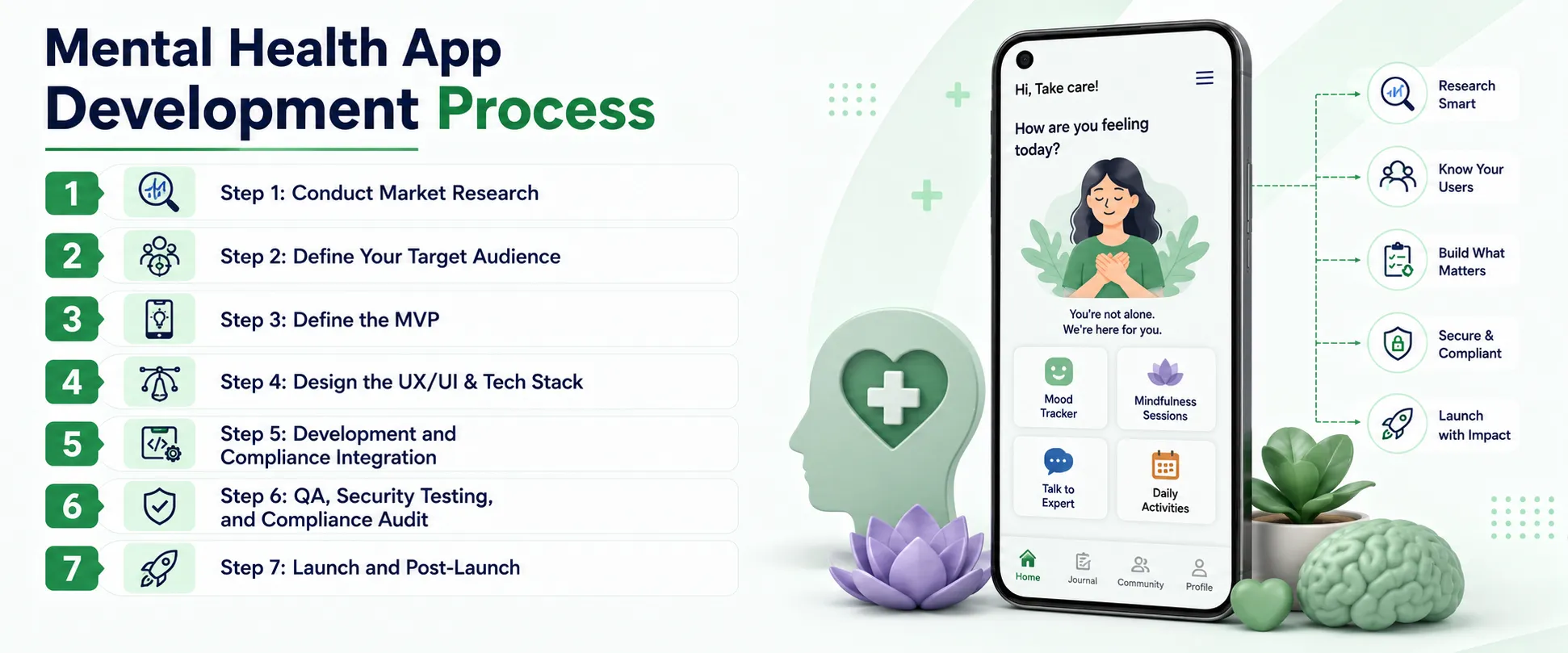
Below are the essential steps to consider:
Step 1: Conduct Market Research
Firstly, understand the market, the competition, and the requirements of the user. Perform an analysis of current mental well-being apps, their features, prices, user ratings, and shortcomings.
Find out where you can fill gaps and what you can do to make your product better.
Step 2: Define Your Target Audience
The mental health application that you develop should be designed for a particular target audience facing particular problems. Who are your users? What are their expectations regarding the application?
Think about their:
- Age and demographics
- Mental well-being objectives
- Pain points
- Digital behavior
- Accessibility needs
- Preferred device/platform
Having a clear target audience will allow making better choices regarding features, design, and personalization of the application.
Step 3: Define the MVP
Build an MVP that includes only the basic features required to address your users’ main problems.
Based on the type of application you wish to develop, the MVP may include such features as:
- User Registration
- Onboarding
- Mood Tracking
- Journaling
- Content for wellbeing
- Notifications
- Progress Tracking
Don’t try to develop too many advanced features at first. Build a product and then use the feedback received to improve it further.
Step 4: Design the UX/UI & Tech Stack
Create an experience that is intuitive, approachable, and trustworthy. Apps for mental well-being should not have complex processes and distractions.
Include:
- Intuitive navigation
- Accessible designs
- Clear content
- Approachable onboarding
- Consistent design
- Privacy-focused processes
On the other hand, choose a technological stack depending on your application’s needs, scalability, and security.
Step 5: Development and Compliance Integration
This is the step when it’s time to make your app idea and design a reality. The mental health app developers create the frontend, backend, APIs, database, integrations, and control panel based on the approved requirements.
In mental wellness app development, compliance and privacy have to be integrated into the product from the very beginning. Depending on the nature of your application, its target audience, and the kind of information that it will collect, you might have to implement some special requirements.
Step 6: QA, Security Testing, and Compliance Audit
Pre-launch, ensure the app is tested for functionality, performance, usability, compatibility, accessibility, and security. Perform the required audit to determine what risks you need to consider.
Step 7: Launch and Post-Launch
Activate the app and monitor its performance, feedback from users, engagement, and security levels. Updating and improving the app periodically will make your mental health application stable and secure.
Common Challenges in Mental Health App Development
A few of the issues that arise in the development of mental health apps due to the nature of these applications include:
1. Safeguarding Sensitive Health Information
Security vulnerabilities can lead to dire consequences.
2. Establishing User Trust
Users require assurance about the proper treatment of their data.
3. Ensuring Engagement
Users may frequently download health apps but fail to engage with them further. Engagement can be improved through genuine utility and not through too many alerts.
4. Complexity of Regulations
Apps related to healthcare may have regulations that vary based on geography and functionality.
5. AI safety
The fAI in healthcare needs proper testing, monitoring, limiting, and escalation.
6. Accessibility
Inaccessibility to an application means exclusion of the people who could have used it for their good.
7. Evidence and Content Quality
If mental health content needs any medical qualification, then it should be made or checked by the right people.
Are You Ready to Make Your Mental Health App Dream Come True?
From developing the Minimum Viable Product (MVP) to more sophisticated technologies such as AI, telemedicine, and user management systems, we at RG Infotech can assist you in building your mental health app.
Future Trends in Mental Health Software Development
There will be further development of mental health technology along the following lines: personalization, connectivity of devices, artificial intelligence, remote services, and digital experiences that tie everything together.
Some areas of future interest may include:
AI-enabled experiences
AI is capable of aiding users in navigation, personalization, content discovery, and other clearly defined processes.
Wearable connectivity
The connected devices could give additional data to be shared by users with applications.
Customized digital interactions
Applications will be able to tailor content and processes to individual preferences and activities more frequently.
Virtual care
Remote mental healthcare may facilitate online interaction and care delivery if legal and clinical guidelines allow for it.
Wellness
There will be an increasing number of applications that concentrate on wellness practices and early involvement, as opposed to problem-solving alone.
How to Choose a Mental Health App Development Company
It is important to choose the right app development company to build a safe and scalable app. Instead of choosing the cheapest one, take into account the following criteria:
- Healthcare Development Expertise: It is important to have an idea of whether they have developed healthcare, wellness, telemedicine, or mental health apps before.
- Portfolio Examples: It is always useful to examine case studies and projects that had similar requirements to your app.
- Security Considerations: Make sure that they know how to work with sensitive patient data.
- Technical Skills: Assess their proficiency in developing apps, back-end technology, cloud computing, API integration, AI, and third-party integration.
- User Interface/User Experience Skills: Select a team that is capable of developing an easy-to-use user interface/user experience.
- Development Methodology: Find out how they conduct their discovery process, MVP development, testing, and deployment processes.
- Transparent Pricing: Ask for a full estimate for design, development, integration, testing, implementation, and support.
- Maintenance Services: Make sure they offer maintenance, security, bug fixing, performance tracking, and new feature development.
- Testimonials: Read independent reviews, testimonials, and references before finalizing your choice.
As mental health applications deal with confidential information of the users, selecting the right development partner is very important.
Partner with RG Infotech, which has more than 15 years of experience in mental health app development services. They will assist you in developing your mental health application in an efficient manner.
Conclusion
Healthcare app development is a combination of mobile technology, user experience, security, privacy, healthcare aspects, and business strategy.
A good application is not supposed to have many features but to be able to solve a specific problem faced by users, deliver reliable experiences, handle information securely, take into account accessibility, and utilize technology responsibly.
The solution is to begin with a highly specialized MVP, validate the MVP with users, build the necessary security and compliance infrastructure, and then introduce advanced functionalities, such as AI, wearable integration, analytics, and telehealth, when it adds value to the product.
To begin developing a mental health application, the first thing that must be done is to identify who the application targets, what specific problem it aims to solve, what features it should have, how it would earn money, where it needs to be used, and what regulations apply.
Contact us to create a secure healthcare application that helps your users improve their mental health. We first determine your MVP and technical requirements and then develop a scalable mental app for patient engagement.