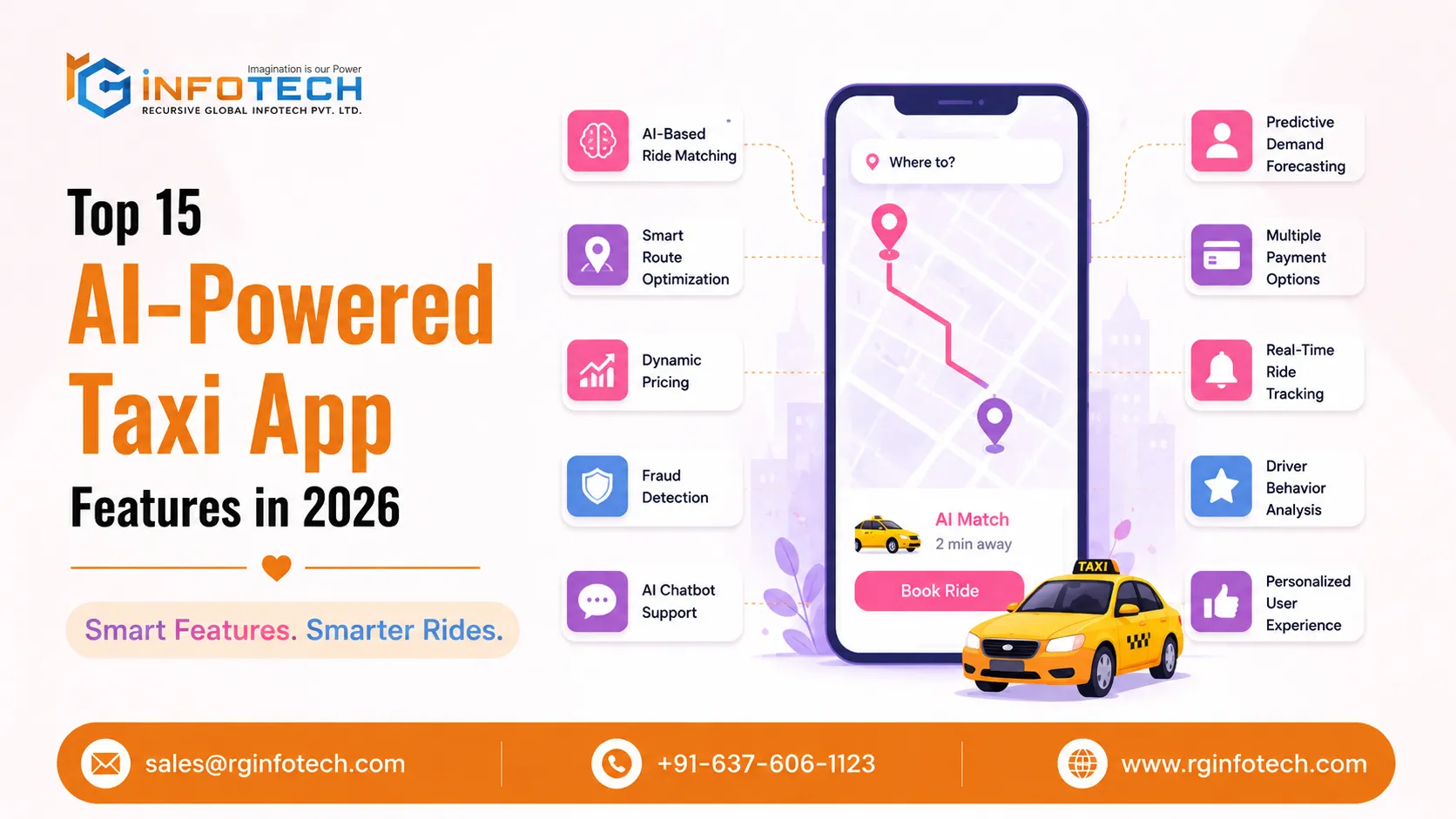
Top 15 AI-Powered Taxi App Features for 2026
The ride-hailing sector is undergoing tremendous changes, and AI has emerged as an important component in modern taxi apps.
The AI ride-hailing app development needs to be more efficient and cost-effective while providing an enhanced customer experience.
The top 15 AI-powered taxi app features that every ride-hailing application must-have to remain competitive in the coming years.
1. AI Driver-Passenger Matching
Matching AI Driver and Rider is the most crucial AI-Driven Taxi App Features. The conventional taxis usually match passengers to drivers by assigning the nearest driver who is available, but through the AI algorithm, the process incorporates various data parameters in order to match passengers with the best-suited driver.
This function helps minimize waiting time, ensure acceptance, enhance driver efficiency, and achieve the best ride experience possible for the passenger.
Example –
Suppose that there is a customer who needs transportation during peak hours. Rather than allocating a nearby vehicle that is caught up in heavy traffic, the AI technology will opt to allocate another one that, although farther, can provide faster service due to less congested roads.
Such wise allocation makes the transportation process efficient and enjoyable for both parties.
Why AI Driver-Rider Matching Is Essential for Taxi Apps
As the race within the ride-hailing industry intensifies, the demands of consumers keep rising. They want fast pick-up times, timely ETA predictions, and quality service delivery. The use of AI driver-rider matching can assist firms in meeting these demands.
2. AI Route Optimization
It enables taxi drivers to find their way to their customers or desired locations using the best possible route based on time, safety, and costs. While GPS navigation technology provides users with just the shortest possible route, route optimization technologies involving AI offer more than that.
The current generation of ride-hailing apps makes use of Machine learning algorithms to optimize routes and make traveling for both passengers and taxi drivers easier.
Example –
Ride-hailing applications use AI technologies to optimize their routes for greater efficiency. Through the analysis of huge volumes of trips on a daily basis, these models keep learning about traffic trends and patterns, enabling them to suggest optimal routes.
Why AI Route Optimization is essential in a taxi app
Intelligent Route Optimization has ceased being an optional luxury and has instead become an indispensable component of taxi applications. It automatically suggests the fastest and most efficient routes, reducing travel time and fuel consumption.
3. Dynamic Pricing Engine
The Dynamic Pricing Engine is among the most influential AI-based capabilities of a taxi app, allowing ride-hailing apps to charge customers according to the dynamic nature of the market situation.
By taking advantage of artificial intelligence, a dynamic pricing engine can set fare prices based on various elements, including but not limited to the number of rides requested, available drivers, and current traffic and weather conditions.
Example –
A big music concert is finishing in a stadium where hundreds of people have booked trips through the app. However, there are very few taxis available for hire to serve these demands. Using the dynamic pricing algorithm, prices would be increased due to the surge in demand.
This would encourage drivers to come closer to this region.
Why Dynamic Pricing Is Essential for AI Taxi Apps –
With the increasing competition in the ride-hailing industry, fixed pricing approaches may not be able to address changing demands quickly. The use of an AI-based dynamic pricing system would allow taxi companies to stay flexible, operate efficiently, boost driver engagement, and generate maximum profits without sacrificing service quality.
4. Predictive Demand Forecasting
The Predictive Demand Forecasting is an efficient AI-enabled function on a taxi app that allows ride-hailing services to predict future ride demands even before they take place.
Through analysis of booking history, behavioral patterns, weather, traffic, holidays, and events in the area, AI can make predictions about where the demand will be higher in the coming days.
With Predictive Demand Forecasting, ride-hailing service providers do not have to react to changes in demand. They can position their drivers in advance, saving time and resources.
Example –
An airport receives more flights on Friday evenings, but a normal ride booking service may not be able to cope with the surge in demand. But an intelligent ride prediction system will understand the pattern and will warn the system before this happens.
Therefore, drivers would reach airports prior to the request for rides so that demand may be met without any delay.
Predictive Demand Forecasting Effect on Business
For any ride-hailing company, demand forecasting becomes a necessity to enhance driver efficiency, avoid waste and inefficiencies, ensure better customer satisfaction, and achieve higher profits due to the accurate prediction of customer demands.
5. Smart ETA Prediction
ETA Prediction is referred to as (Estimated Time of Arrival) Prediction. The prediction of the accurate arrival time is important in making both drivers and customers satisfied.
The traditional taxi apps normally depend on information such as distance and speed for the prediction of the arrival time of a driver. But AI apps make use of many other factors like real-time traffic, weather conditions, and driver location. Historical traffic trends, route complexity, and many more to predict the arrival time more precisely.
Example –
A user is trying to book a cab ride during peak hours. In the case of a regular app, the app would simply show an estimated wait time of 10 minutes, depending on distance alone. The Smart ETA with AI would consider all of these things and give a more accurate prediction of wait time, which is 15 minutes.
Why Smart ETA Prediction Matters for Taxi Apps –
Smart ETA Prediction assists firms in enhancing customer retention, minimizing complaints, boosting fleet management, and creating an exceptional user experience. If you want to develop a taxi app using AI, smart ETA prediction is a must-have in your transportation app.
6. AI chatbot Integration for Customer Support
AI Chatbot for customer support has become one of the most vital parts of ride-hailing apps. They are equipped with the latest technologies of AI and NLP.
These software solutions can understand the requests of customers, give appropriate answers to them, and solve common problems without human involvement.
Example –
An individual seeks the current position of their ride during busy hours. Rather than seeking assistance from a support representative, one may directly address the chatbot:
“Where is my driver?” support representative, one may directly address the chatbot:
In this instance, the AI chatbot fetches ride details almost instantly and delivers relevant information.
Why AI Chatbots Are Essential for Taxi Apps
Artificial intelligence chatbots allow taxi companies to provide better customer experience, decrease their support burden, and improve the efficiency of their operations. Customer retention can be huge through providing prompt service throughout the entire ride.
7. Voice Assistant Integration
AI-enabled taxi applications allow passengers to request rides, monitor their trips, and manage their bookings through voice commands. The power of Artificial Intelligence (AI), NLP, and speech recognition technologies facilitates fast and effortless interaction with the application.
Voice integration has become one of the primary features that differentiates modern taxi applications from competitors.
Example –
A customer walks out of the shopping mall carrying several bags. Rather than opening the app, they just ask,
“Book me a cab to go home.”
The AI then determines their location automatically, picks the default mode of transportation, checks for availability, and books the cab.
Why Voice Assistant Integration Matters
Voice assistant integration enables users to interact with the voice command. For companies investing in AI-powered taxi app development, this feature improves usability, increases accessibility, and strengthens overall customer experience, making it a valuable component of next-generation mobility platforms.
8. Fraud Detection & Prevention
AI features used in taxi apps prevent any potential harm caused by fraudsters, scams, and misleading activities with AI security features. As scams start occurring, manual checking becomes less effective; therefore, artificial intelligence and Machine learning algorithms are used to detect any abnormal behavior.
The analysis of user interactions, payments, and rides performed constantly is crucial for providing safe services to everyone involved. occurring, manual checking becomes less effective; therefore, artificial intelligence and Machine learning algorithms are used to detect any abnormal behavior.
Example –
When the user tends to take long routes to make more money from each ride. The algorithm will recognize that the route differs significantly from the recommended one and raise an alert.
The same thing happens if a person books several orders in a short period of time using various payment cards and devices.
Why Fraud Detection Is Essential for Taxi Apps –
Ride-hailing services have experienced growth over the years, and with this comes increased chances of fraud. With the implementation of artificial intelligence-based fraud detection, the ride-hailing application becomes more secure and safe to use.
9. Personalized Ride Recommendations
Artificial intelligence, which provides a customized experience by offering ride choices, prices, types of vehicles, and recommendations according to each customer’s behavioral pattern.
In other words, AI gives personalized experiences for every user rather than providing similar experiences for all customers.
Today, personalization is essential for ride-hailing apps.
Example –
A rider who always makes reservations from his house to the office at 9:00 AM every day opens the application.
Rather than beginning from scratch, the AI-based software suggests to him.
“Your regular office ride is up for reservation. Reserve now for pick-up time 9:00 AM?”
Thus, it saves his efforts by providing a one-click booking facility.
Why Personalized Ride Recommendations Matter
Personalized Ride Suggestions play an important role in enhancing the user experience within the highly competitive market of ride-sharing services. It adds to the smartness of the Ride-sharing platform, making it user-friendly and intuitive.
10. Driver Performance Monitoring
AI technology enables ride-hailing companies to monitor their drivers’ performance, analyze and improve it constantly.
Through artificial intelligence, taxi apps have become capable of guaranteeing safe transportation for customers.
In contrast to manual driver monitoring, AI-based driver performance monitoring is constant throughout all trips made by drivers.
Example –
A certain driver gets a lot of low ratings owing to sudden stops and frequent changes in routes. In such a scenario, the AI software detects it and alerts the company.
Why Driver Performance Monitoring Is Important
The behavior of the driver is directly responsible for customer satisfaction, safety, and reputation. AI-based Driver Performance Monitoring guarantees that only qualified and dependable drivers can take orders via the app.
When you develop an AI-based taxi app, you must implement the mentioned feature into your system.
11. Real-Time Traffic Intelligence
Real-time tracking in taxi applications provides the ability to assess real-time traffic conditions and update routes accordingly.
With the help of Artificial Intelligence (AI), Big Data technologies, and geolocation systems that work with GPS, taxi apps are able to greatly enhance their performance.
AI constantly analyzes traffic patterns and makes better decisions based on the collected information.
Example –
A driver is making his way to pick someone up at a time when the office is full of people. The artificial intelligence system detects that there is traffic on the major street and immediately redirects him through another faster path based on real-time traffic.
Meanwhile, the passenger gets a new ETA for the ride.
Why Real-Time Traffic Intelligence Matters –
With Real-Time Traffic Intelligence, every journey is optimized for speed, precision, and reliability.
When developing AI-driven taxi apps, this is helpful for eliminating inefficiencies and providing an efficient ride to the user.
12. AI-Powered Safety Monitoring
AI-powered taxi apps are employed to guarantee the safety of passengers and drivers during each journey.
Using technologies such as Artificial Intelligence (AI), machine learning, computer vision, and sensor data, ridesharing services are able to mitigate risk and improve response times in case of an emergency.
Example –
A customer orders a taxi ride late at night. While traveling, the AI system discovers that the driver is deviating considerably from the intended route and making a prolonged stop in an isolated location.
.
The system will immediately:
- Send an alert to the client
- Notify the safety monitoring team
- Provide real-time information about the ride to emergency contacts
This approach prevents safety issues from occurring.
Why AI-Based Safety Monitoring Is Essential –
In the ride-sharing industry, there is no room left for anything else but safety. This is guaranteed through AI-Based Safety Monitoring, which allows the detection of any potential threats at an early stage.
13. Automated Fleet Management
Automated Fleet Management effectively manage their vehicle fleet through Artificial Intelligence (AI), machine learning, and data analytics. This system minimizes human intervention, enabling higher efficiency, reduced expenses, and increased availability of services.
For taxi services operating on a large scale, controlling a few hundred or thousands of taxis manually does not work very well. AI-based automation makes the process more efficient and effective.
Example –
As a result of high demand for rides during office rush hour in an area designated as a business district, AI sends vehicles from other areas of lower demand into the high-demand location.
At the same time, AI takes care not to send cars that will soon be due for maintenance on long routes.
Why Automated Fleet Management is Important –
Efficient fleet management is critical to the success of any ride-hailing operation. The system guarantees optimal utilization of vehicle resources, driver resources, and other assets.
For the development of artificial intelligence-driven taxi service applications, this functionality plays an important role in ensuring cost savings and scalability.
14. Surge Demand Prediction
AI technology embedded in an application used by taxi services, which is able to predict a surge of ride demands before such demand happens.
By using AI and predictive analytics technologies, this service can forecast the upcoming spike in demand for rides.
By doing so, taxi services are able to prepare for high demand ahead of time.
Example – A cricket game is about to conclude at 10 p.m. inside the stadium. The use of AI suggests a surge in ride requests at that time.
Before the game ends, the AI system will:
- Notify nearby drivers to position themselves near the stadium
- Adjust prices for a surge
- Enhance the availability of rides nearby.
This leads to quicker pick-ups and increased driver revenue.
Why Surge Demand Prediction Matters –
Within the field of ride-sharing, unexpected bursts in demand could lead to issues such as delay, cancellation, and lack of income. Surge demand prediction assists in solving all of these challenges by allowing for better preparation.
Surge demand prediction is a fundamental aspect of developing an AI taxi booking app for businesses.
15. Customer Retention Analytics
Customer Retention Analytics is an essential AI-based module in taxi apps that aims to understand customer behavior and enhance consumer loyalty. The use of AI technology enables companies to predict reasons for losing their customers and take measures to retain them.
In the cutthroat market of taxis, it is costly to gain new users; therefore, retention plays a vital role in business profitability.
Example –
An individual who uses ride services five days per week decreases his frequency of usage to once every two weeks.
The AI recognizes the behavior pattern and tags the user as “at risk.” This leads to:
- Discount offers sent via automated messaging
- Recommendation on popular travel routes
- Notification of the customer support team to follow up
This results in engaging the user again to use the service.
Why Customer Retention Analytics Matters
In the ride-sharing market, customer retention is less costly than customer acquisition. Thanks to Customer Retention Analytics, a taxi app can understand its clients’ expectations, detect any disengagement, and make the necessary improvements.
It is necessary for enterprises developing AI-driven taxi solutions.