Summary:
This blog tells us that the return on investment on a travel app is significant, owing to the rapid digital transformation that is currently being seen in the travel industry. Not only does it allow companies to have more users, but it also allows companies to earn money in several ways.
As travel technology continues to grow, investing in a travel app is a profitable move to capitalise on the future of the digital travel ecosystem.
The benefits of investing in a travel app are becoming essential as the travel industry is being transformed by mobile apps.
With the rise in mobile app usage and digital booking, business owners are shifting to an AI-powered travel app solution to capture a share of the market.
With the rise in smartphone demand and the digital booking trend, investing in a travel app has become a profitable opportunity for startups and established businesses.
A travel app helps in streamlining the traveller’s journey, redefining their experience and the people who are in the travel business. Creating an app can lead to multiple competitive advantages for a business.
To have all this, you need to contact a travel app development company in India; they are a real source for your success in the travel industry.
Key Takeaways for travel app market growth:
The global online travel industry growth is around $645 billion in 2024, showing continuous growth.
Travel apps have generated around $1.1 trillion in 2025.
Mobile applications accounted for around 52.36% in 2025.
More than 850 million people use travel apps to travel globally.
Top companies like Booking Holdings have generated revenue of around $24 billion in revenue in 2024.
What Are the Benefits of Investing in a Travel App?
Investment in a travel application is profitable for several reasons, such as a great return on investment, international presence, scalability, and various ways to monetise. Due to the increasing need for digital services in the travel industry, companies can earn money continually and attract customers worldwide.
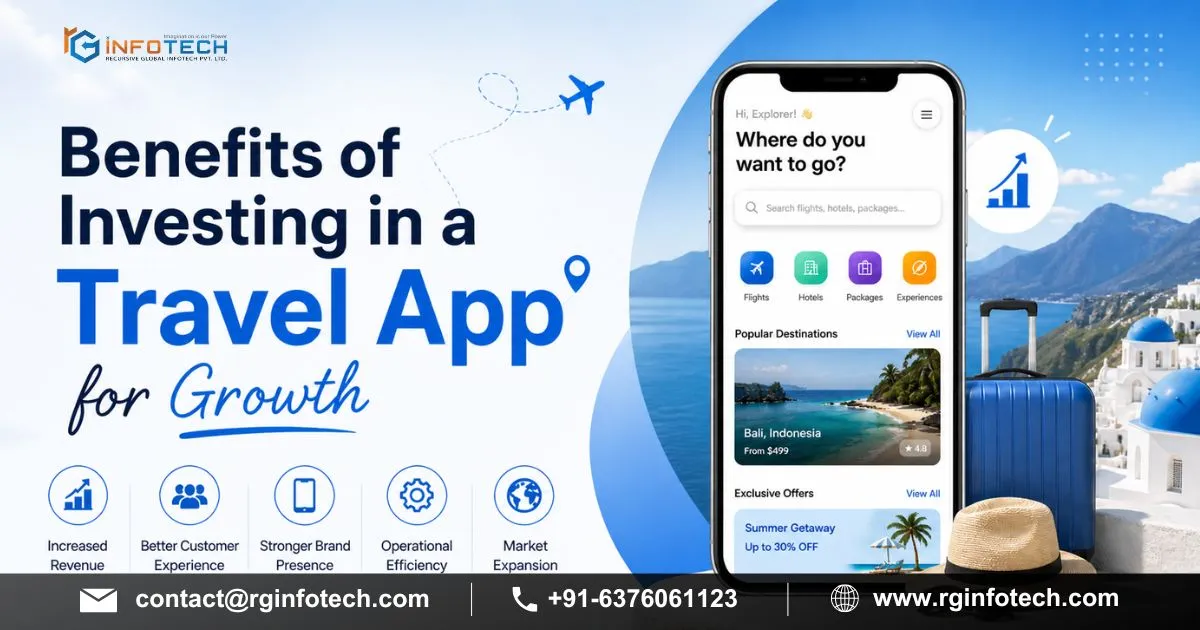
Here are the top eight benefits of investing in travel and tourism app development: it is a smart move for businesses in this sector.
Do You Have an Idea for a Travel Application?
Work with RG Infotech to develop a scalable travel app that meets your business needs. Reach out to us today and make your dream a reality.
8 Key Benefits of Investing in a Travel App Development
Travel app Development offers you a wide range of investment advantages, mainly related to higher revenue potential for investors. Below are the key benefits that make a travel app a smart investment in today’s digital economy.
1. High ROI Potential
One of the biggest advantages of travel apps for businesses is their high return on investment. Travel apps are generating revenue from multiple sources, such as bookings, commissions, in-app advertisements, subscriptions, and affiliate partnerships.
With the right monetisation strategy, business can recover their development costs easily and achieve profits within a shorter time span.
2. Global Market Reach
The use of a travel app gives companies the opportunity to address a global market without being constrained by geography. This can be achieved through language options and payment systems that cover the global market.
The travel mobile app benefits travel agencies to operate for international audiences and offer multilingual and currency support. This helps in increasing revenue potential.
3. Scalability and Business Growth
Travel apps are extremely scalable. Companies can begin by incorporating necessary components and then expand on their applications by implementing more complex options such as AI-based suggestions, dynamic pricing models, and loyalty rewards.
The flexibility makes them an ideal choice for startups and enterprises.
4. Multiple Revenue Streams
One travel application can earn money from different areas, such as:
- Hotel bookings
- Flight bookings
- Tour packages
- Travel insurance
5. Improved Customer Experience with AI
Chatbots utilising AI in travel apps offer better experiences for users through quick responses, personalised suggestions, and round-the-clock assistance. Such improvements result in customer satisfaction and loyalty.
Today’s customer wants instant booking, real-time updates, and personalised suggestions. Apps that deliver a smooth experience build stronger customer loyalty and retention.
6. Streamlined Operations and Increased Efficiency
Travel applications simplify essential tasks like booking, cancellation, and customer service. This saves time and effort, lowers risks of errors, and enhances efficiency in business operations.
Travel helps in managing all things under one roof while automating routine tasks and workflows.
7. Real-Time Analytics for Better Decision-Making
Through real-time analysis of their applications, travel companies gain important insights regarding user behaviour and preferences, which aid in making informed business decisions.
Data is essential for business owners to track customer requirements, choices, upcoming mobile travel booking trends, and revenue patterns. Real-time analytics helps them to optimise their travel services and pricing strategy.
8. Competitive Advantage
An efficient travel application can be very helpful in ensuring that businesses have an advantage over their competitors. Businesses that adopt technology early enough will be able to get a bigger share of the market.
Benefits of Using Mobile Apps in the Travel Industry
Mobile applications have revolutionised the tourism industry because they have enabled trip planning to be quick, convenient, and even highly personalised. Whether for flight bookings or navigating destinations, travel apps are indispensable for improving both customer satisfaction and company operations.
1. Easy Booking and Planning
These applications provide the ability to book air tickets, hotel accommodation, and sightseeing tours at any time and from any place. In doing so, it renders the use of traditional travel agencies obsolete, allowing for easy planning in just a few clicks.
2. Real-Time Information and Notifications
Users will get instant information about their flight, booking confirmation, delays, and cancellations through this real-time mode of communication.
3. Personalised Travel Experience
These applications use artificial intelligence and data collected from users to provide personalised recommendations like destination suggestions, hotel suggestions, and travel itineraries.
4. Convenient Navigation and Trip Management
All navigation and itinerary information can be accessed in one application, eliminating the need for users to switch between different applications while planning their trip.
5. Safe and Contactless Payments
Users can pay through various means via mobile applications, such as digital wallets and international payment gateways, to ensure secure payments.
6. 24/7 Customer Support
Customers can get their queries addressed round-the-clock using tools like AI chatbots within the app to boost user confidence.
7. Cost Reduction and Unique Offers
Many travel apps provide their users with exclusive discounts, promo codes, and loyalty rewards for saving on their travels.
Real Examples of Successful Travel Apps
It becomes easy to comprehend the advantages of spending money on a travel app once you see real-world examples. There have been many startups that were just an idea but became multibillion-dollar companies.
Airbnb - Transforming the Hotel Industry
By letting people rent out their houses to travellers, Airbnb revolutionised the hospitality industry. No longer limited to staying at traditional hotels, travellers can choose from a range of affordable and interesting options provided by Airbnb around the world.
- Developed a scalable travel booking app business model
- Harnessed the power of user trust and reviews
- Established multiple revenue streams
Booking.com – Best travel apps in the world
Booking.com is one of the largest travel agencies, providing accommodation, flight, and car booking services, among others, all on one platform.
- High emphasis on usability and convenience
- Large global database of accommodations
- Personalized approach based on data for high conversion rates
MakeMyTrip – Dominating the Indian Travel App Scene
MakeMyTrip is a perfect case study for how to dominate the travel app market within a specific region through localised solutions.
- Localisation of features
- Payment methods
- Effective use of mobile strategy
- Effective marketing
TIP: These successful platforms highlight the following things to keep in mind while building a travel app:
- Travel applications provide unlimited possibilities for scaling
- The travel app user experience and credibility determine the growth factors
- Many revenue sources guarantee sustainable profitability
Are you Planning to Venture Into the Fast-Growing Travel Market?
Allow RG Infotech to assist you in developing a highly advanced travel app. Get in touch with us today to start your journey.
Travel App ROI VS Travel App Development Cost
Perhaps one of the most frequently asked questions about the development of an application for the tourism and travel industry is whether the expenses for its creation are worth the profit that it generates. In brief, yes—but only if it is done properly.

What Does it Cost to Develop a Travel App?
Many variables affect the travel app development cost and the benefits of travel app development. To know the detailed cost breakdown, check our guide on travel app development cost in 2026.
The Average Cost Estimation is:
- Basic Travel App: $10,000 – $25,000
- Intermediate Travel App: $25,000 – $60,000
- Advanced Travel App: $60,000 – $150,000+
Monetisation Opportunities for a Travel Application
There are many ways to monetise a travel application, including:
- Commission from bookings (flights, hotels, tours)
- Subscriptions
- In-app advertising
- Affiliate marketing
The travel industry is still growing, and mobile apps are one of the major factors contributing to its expansion. Early investment and proper execution can make your platform sustainable and extremely profitable.
Future Trends in Travel Apps
As travel apps continue to evolve amid advances in technology and shifts in consumer behaviour, we can see that the future holds much more for travel apps than what is currently offered. To get into detail about the emerging travel technology trends, check our esteemed guide on the Top Travel App Development Trends.
1. AI Travel Assistants (Agentic AI)
AI isn’t just an add-on but rather an intrinsic part of travel apps. Travel apps rely on artificial intelligence for planning travel routes, destination suggestions, and automatic bookings.
As per industry experts, AI is progressing from being mere tools to becoming what they call “agentic systems” that facilitate end-to-end travel management.
Travel apps will become personalised travel assistants.
2. Emergence of Super Apps in Travel
Travel technology trends are evolving into a comprehensive suite of services combining various features such as booking, transportation, meals, and entertainment.
Recent trends reveal firms merging hotel bookings, transportation, and other local facilities within one app.
The user will have everything in one application rather than using multiple applications during their travels.
3. Hyper-personalisation via Data
Today’s travellers demand a very personalised service that caters to their tastes, behaviour, and history of booking.
Mobile applications are now relying heavily on data analytics and artificial intelligence to provide customised recommendations.
There will be no generalised travel advice; instead, each traveller will receive a personalised travel experience.
4. Voice Search and Conversational Booking
Voice-driven search is gaining traction in travel apps, where users can now plan their trips, compare prices, and book services through conversations.
Users will plan their trips not by typing but by speaking.
5. Integration with AR/VR for Immersive Experience
Augmented Reality (AR) and Virtual Reality (VR) are revolutionising the way travellers experience destinations before visiting.
- Virtual tours of hotels
- AR-powered navigation
- Virtual preview of destinations
6. Social Media and Travel Discovery Through Content
Social media is now emerging as an important source of inspiration for travel. People today depend more than ever before on social media content for discovering new travel destinations and activities.
The travel industry will incorporate the following social media functions into their travel applications:
- User-generated content
- Influencer insights
- Community-based reviews
Conclusion
In the year 2026, investing in a travel application will no longer be an act of following trends but will become a crucial decision for any business looking to enter the rapidly growing market of digital transformation in tourism.
If you are ready to turn your travel app idea into a profitable business, then you require a travel app developer to open your revenue stream, but also help you stay competitive in the digital world.
RG Infotech, one of the best travel app development companies in India, helps in developing high-performing applications to suit your requirements.
With us, you can be assured of getting your travel application developed from scratch to completion within your stipulated time frame.