Summary:
The blog focuses on the various kinds of travel applications and how to generate good business opportunities from each.
It provides detailed information on the features, issues, and monetisation techniques of travel applications to help businesses determine which to opt for based on their requirements.
Over time, you can see that different types of travel apps are shaping the future of the tourism mobile apps industry. The travel industry is rapidly growing, and mobile apps are now the centre of how people plan, book, and experience their vacation.
Mobile phones are the most used tool while planning a trip. I think people rely more on mobile phones for all comforts, from getting navigation for the destination to booking a flight, hotel, or getting a ride to the hotel or airport. Everything is at one’s convenience with mobile app development.
Travel app development has changed how people plan their trips. The different types of travel apps, like booking apps, flight, navigation, Itinerary, and ridesharing apps, are making trip planning smoother and cheaper.
This guide breaks down information about highly profitable types of apps for travelling, with their travel app features, application examples, and additional business information for entrepreneurs.
Key Takeaways:
Over 900 million people used travel apps in 2024.
Around 44-45% of bookings are made directly from apps.
Platforms like Booking and Expedia dominate a major share of global bookings.
AI-driven marketing leads to Travel app growth, which contributes to over 75%.
Users spend over 20 billion hours on travel apps.
Why Choosing the Right Travel App Type Matters
Choosing the right type of travel app for your business is one of the most important decisions in the travel app development process. With so many travel app business ideas available from booking platforms to AI-powered itinerary planners, selecting the wrong travel app can lead to a waste of investment.
These travel apps help with everything from day-to-day hotel bookings to flight bookings and changes. These apps are used by every traveller on the trip.
Different types of travel apps serve different purposes; each comes with its own development complexity, target audience, and monetisation strategy.
If you are planning to build a travel app, then choosing the right one will become the priority since the type of your app defines your income model, development price, and the target users.
Understanding these differences helps you in selecting the right travel app for your business:
- Make sure that your application suits your business objectives
- Select proper travel app features and tech stack
- Save money and minimise risks in development
- Increase user loyalty and involvement
Let’s Begin Making Your Travel App?
Transform your ideas about travel apps into reality through professional assistance. Create scalable, feature-packed, and user-centric travel applications that suit your business requirements with RG Infotech. Embark on your path towards success now.
Top Types of Travel Apps for Your Business to Build in 2026
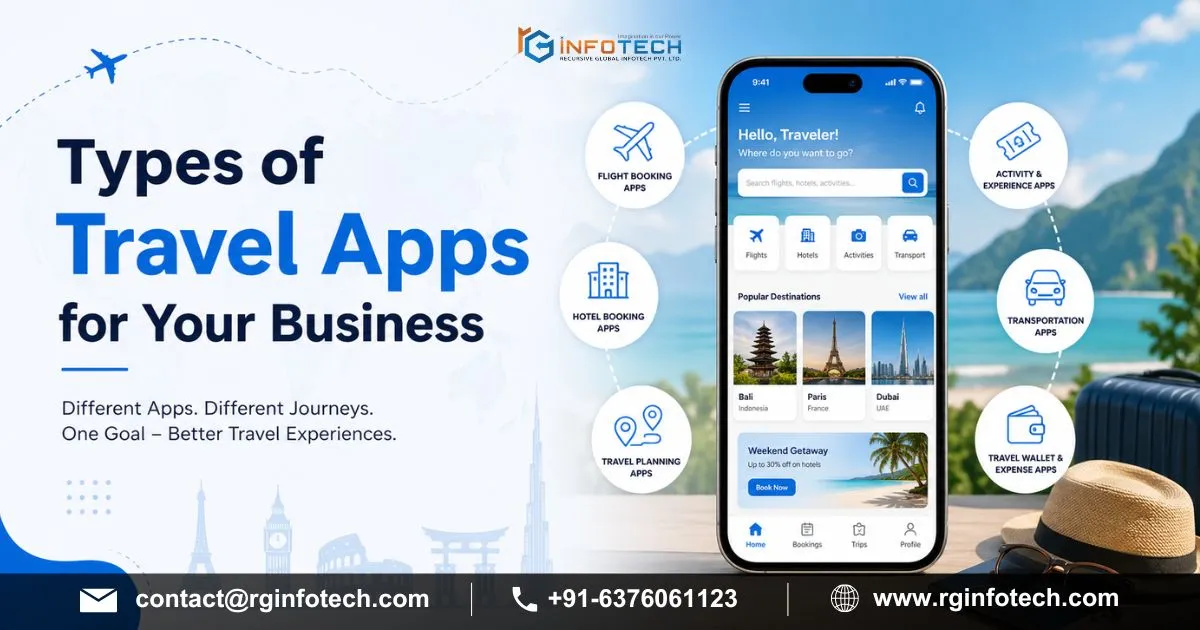
Getting to know in detail about the main types of travel apps for your business is important in planning your travel app development strategy. Each travel mobile app category serves different user needs and offers unique opportunities for monetisation and innovation.
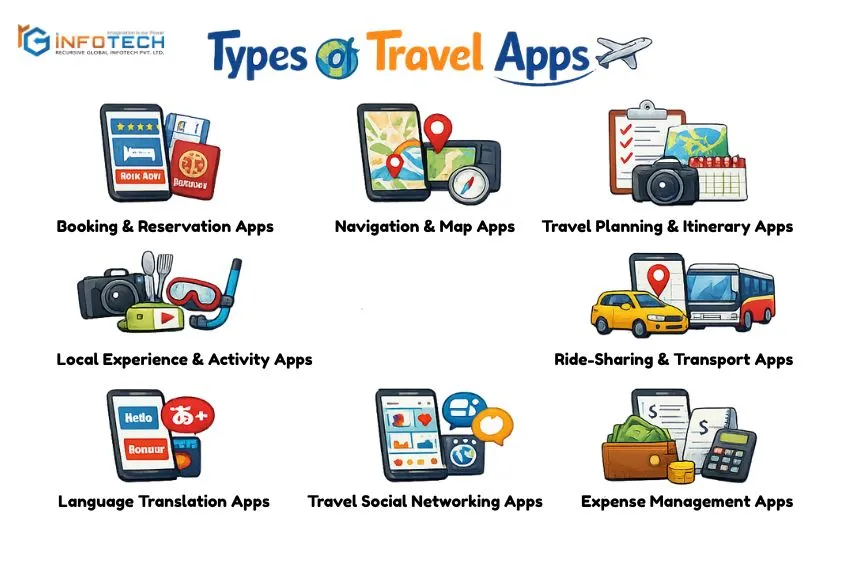
With the advanced development of artificial intelligence, people use AI-powered travel apps to get a more personalised user experience. The market offers a wide range of travel app business ideas that you can explore.
The key is to choose a travel app business model that aligns with your business goals.
Here are the most profitable types of travel apps you can consider for development in 2026:
App Type
Target Users
Travel App Development Cost
Monetization
Booking Apps
Mass travelers
High
Commission
Navigation Apps
All travelers
Medium
Ads
Planning Apps
Organized travelers
Medium
Subscription
Experience Apps
Explorers
Medium
Commission
Transport Apps
Urban travelers
High
Commission
Translation Apps
International users
Low-Medium
Freemium
Social Apps
Travel communities
Medium
Ads
Each comes with different features, development requirements, and revenue models. Let’s explore in detail to help you choose the best fit for your project.
1. Booking & Reservation Apps
Travel booking applications are among the most profitable types of travel apps for your business. These apps allow users to book their flights, hotels, holiday packages, and all other travel services related to booking and reservation in one place.
Platforms like Expedia and Booking.com follow this structure and also set the benchmark by providing a smooth booking experience, real-time availability and competitive pricing in one place.
What Do Booking Apps Do?
- Facilitate searching and comparison of travel alternatives
- Allow users to book trips in real time (flights, hotels, packages)
- Provide payment gateway services
- Offer discounts and reward programs
- Search capabilities (price range, location, rating)
- Payment services
- Real-time booking
- Booking history & e-tickets
- Intense competition
- Requirements for integration with other APIs
- Dependence on collaboration with providers
- Difficult-to-implement backend systems
You can consider building a niche travel booking application that includes budget travel, luxury stays, or regional tourism. This reduces competition and helps you grow faster in the crowded travel app development market.
2. Navigation & Map Apps
Navigation and maps are the most essential trip-planning apps that help users move easily from one place to another. It is the best way to find the fastest route to the destination, avoid traffic, or discover new places.
These apps play an important role in the overall trip experience of the traveller. The most popular examples of this are Google Maps and Waze, which have set high standards by providing real-time updates and the shortest route to the location.
What Does a Navigation App Do?
- Enter a destination
- Get the best route
- Follow directions in real time
- GPS Navigation: Location tracking and directional services
- Traffic Information: Helps one navigate traffic effectively
- Offline Maps: Accessible even in areas without internet connections
- Route Optimisation: Determines the shortest and fastest routes
- Voice Navigation: Voice guidance for drivers while navigating
- Points of Interest: Search for hotels, restaurants, and fuel stations.
- Real-time data accuracy
- Complexity in development due advance GPS integration and API mapping
- Dependency on third-party API
- Offline functionality Limitations
- Market competition
With the integration of artificial intelligence and real-time data, navigation apps are becoming more personalised, providing more opportunities for business owners who wish to enter this travel space.
3. Travel Planning & Itinerary Apps
Travel planning apps are designed to help users organise every aspect of their trips in one place, from flights and hotel booking to all the daily activities and notification reminders.
A travel itinerary app helps users to plan, organise, and manage all the aspects of the trip, which includes scheduling, booking, and other activities in one platform. Well-known platforms like Triplt and Roadtrippers provide centralised planning for the trip.
What Do Travel Planning Apps Do?
- Plan your trip itinerary
- Store your bookings (plane tickets, hotel stays, etc.)
- Plan your daily activities
- Get notifications about the status of your plans
- Itinerary Management
- Booking Services
- Intelligent Notifications
- Collaborative Features
- Offline Mode
- Artificial Intelligence
- Difficulty in integrating data (flights, hotels, attractions)
- Ensuring real-time updates
- Personalisation of users’ preferences
- High level of competition in the travel technology market
With the growing demand for personalised travel experiences, less dominance compared to navigation apps, high user intent, and strong potential for AI integration, these are ideal for startup who are looking to build a digital travel assistant.
4. Local Experience & Activity Apps
These apps work as virtual local travel apps, enabling travellers to discover what to do at the destination, rather than just booking flights and hotels. These apps basically focus on experiences, from sightseeing and events to hidden gems and cultural activities.
Popular platforms like TripAdvisor and GetYourGuide are using these powerful travel mobile app categories, which can influence travellers’ decisions. These apps bring the tourist experience closer to the local experience.
What Do Local Experience Apps Do?
- Find local points of interest
- Schedule tours, events, and activities
- See reviews and ratings
- Experience locations like locals do
- Activity Search
- Booking and Reservations
- Reviews and Ratings
- AI-Based Personalisation
- Interactive Maps
- Event Listing
- Providing up-to-date information
- Making sure that reviews are genuine
- Developing partnerships with local vendors
- High levels of competition in popular tourist areas
Local experience apps help travellers to discover, explore and book activities, attractions and events online from their devices at their destinations. It also provides personalised and locally based recommendations.
5. Ride-Sharing & Transport Apps
Ride-sharing apps have transformed how people travel within cities and across destinations. These apps act as a digital transportation system that connects users with drivers or transport services in real time. They offer a fast and cost-effective way to travel.
Some of the top platforms, like Uber and Ola, have marked their industry standards by making transportation easily accessible with a few taps on your mobile phone. These apps make life easier for residents and tourists in cities.
What Do Ride-Sharing & Transport Apps Do?
- Book rides immediately or in advance
- Select different modes of transport (bike, car, taxi, etc.)
- Monitor drivers’ location online
- Process payments electronically
- Real-Time Ride Booking
- Live Tracking
- Fare Estimation
- Multiple Payment Options
- Ratings & Reviews
- Ride Scheduling
- Driver supply and recruitment issues
- Intense competition in city centres
- Legal and administrative issues
- Concerns about safety and trust
- Surge pricing without causing customer disappointment
The ride-sharing app is going to fulfil the demand for on-demand transport and lead to the expansion into tier-2 and tier-3 cities. It is a highly profitable business when executed well.
6. Language Translation Apps
Language translation apps serve as a real-time communication assistant for travellers. The importance of language translation apps cannot be overstated for those who are travelling to foreign countries. Such apps make sure that people are not hindered by language problems when they visit foreign nations.
Google Translate app and other popular language translation apps have made life easier for thousands of people across the globe. They help in making foreign travel easy.
What Do Language Translation Apps Do?
- Translating text from one language to another
- Converting speech to another language immediately
- Translating images (signs, menus, documents)
- Enabling communication in the local language even without prior knowledge
- Text Translation
- Voice Translation
- Camera Translation
- Offline Mode
- AI-Powered Accuracy
- Phrasebook
- Translation quality and context recognition
- Slang, dialects, and regional differences
- Speed of real-time operation
- Restrictions on offline usage
Language translation apps refer to programs that facilitate the translation of languages through text, voice, or image in real-time communication to help with communication when travelling.
7. Travel Social Networking Apps
These applications bring together the world of social media and travel, enabling their users to interact, share experiences, and explore different types of travel opportunities via community-based networks. Such applications are ideal for today’s travellers who seek real advice and first-hand experiences over guidebooks.
Examples of popular applications such as Couchsurfing and Travello demonstrate just how effective community-based travel can be.
What Do Travel Social Networking Apps Do?
- Exchange experiences
- Post photographs from their travels
- Meet people who travel
- Explore places through user-generated content
- Participate in travel-related groups
- User Profiles
- Content Sharing
- Messaging & Networking
- Location-Based Discovery
- Location-Based Discovery
- Creating a critical mass of users (network effect)
- Moderation of content and prevention of spam
- Ensuring user security and trust
- Rivalry with big social networking sites
Travel social networking apps are applications where users can interact and exchange travel stories within a community of fellow travellers.
8. Expense Management Apps
Travel expense applications assist travellers in managing their expenses throughout the trip. Expense management applications are more convenient for business travellers, frequent flyers, and travellers who would like to keep their budget intact while on trips.
They assist the user in having full knowledge and management of their travel budget. Applications such as Expensify and Trail Wallet are commonly employed for the purpose.
What Do Expense Management Apps Do?
- Monitor daily travel app development cost
- Classify expenditures (meal, lodging, transportation, etc.)
- Automatically convert foreign currencies
- Create expense statements
- Expense Tracking
- Budget Planning
- Multi-Currency Support
- Reports & Analytics
- Receipt Management
- Integration of travel app features
- Being too tired to enter data manually
- Currency conversions being inaccurate
- Concerns regarding the security of data
- Incompatible with multiple payment systems
Expense management apps for travel are applications that assist users in managing their travel expenses by tracking and organising them.
Let’s Develop Your Unique Travel App
Do you wish to develop an app for reservations, scheduling, or any other travel application?
Then get associated with RG Infotech to have your travel application developed. Contact us today to launch a successful travel application.
How to Choose the Right Travel App for Your Business
Choosing the appropriate development partner is key to ensuring the success of your travel application. Choosing the right type of app depends on:
- Target audience
- Budget
- Market demand
- Competition analysis
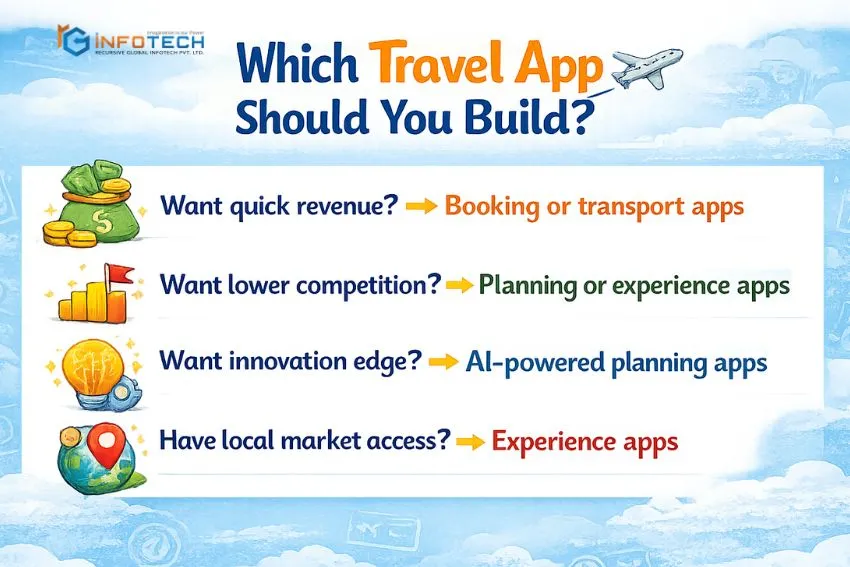
In the midst of numerous development partners, RG Infotech is the best travel app development company in India.
- Over 15+ years of experience in Travel App Development
- Custom travel app development Services
- Advanced Technology & Agile Development
- Secured Applications
- Global Client Base & Proven Track Record
- Cost-Effective Development in India
Conclusion
Travel applications have become necessary in the current era of travel because there are many options to choose from. There are solutions ranging from booking to mapping and planning, local experience discovery, and even expense management. Each of the different types of applications offers different entry points into the travel industry.
The kind of application that one should select will depend on one’s objectives in terms of target market and market requirements.
Working with an established firm such as RG Infotech will ensure that your travel application is of high quality and scalable.
Success, however, depends on knowing what the users want and creating a solution accordingly.