Summary:
Choosing the best cross-platform framework in India is essential for Indian companies to develop mobile applications that are cost-efficient, high-performing, and scalable. This blog post compares Flutter and React Native on various parameters such as performance, UI/UX, development time, cost, and maintenance.
Selecting the right framework is one of the most crucial decisions to be made when you’re developing a mobile app, and this is even more important in a rapidly growing country like India.
Currently, two frameworks are leading the way in cross-platform app development: Flutter and React Native.
If you are thinking of starting a new mobile app development project, the question that pops up in everybody’s mind is: Flutter vs React Native: Which is better for Mobile app development in India?
To respond to this question, we will compare both frameworks from an Indian business perspective, based on Performance, Cost in India, hiring developers, startup vs. enterprise, and many more.
Let’s get involved with these frameworks in depth to see which one is better.
Cross-Platform App Development in India (2026)
A cross-platform app development company in India serves as a strategic partner to many clients. They are not just code writers; they assist in selecting the appropriate technology to address the challenges posed by India’s low bandwidth connectivity and high device fragmentation.
In 2026, the Indian mobile industry is more competitive than ever. With more than 1 billion smartphone users, businesses can no longer afford to develop apps on just one platform. Cross-platform app development has shifted from being an alternative to the industry standard.
Why do Indian businesses prefer cross-platform frameworks?
Currently, the Indian startup community, ranging from the humble Grocery Store to the established Fintech unicorns, is focused on three aspects: Speed, Cost-Efficiency, and reach.
By using a single codebase to target both Android and iOS, companies are cutting their time-to-market by almost 40%. In a market where “fastest finger first” gets the customer, cross-platform is the clear winner.
In this blog, we will compare Flutter and React Native from an Indian business perspective, including performance, cost, talent acquisition, startups, and enterprises, so you can make an informed decision.
Before diving into the comparisons, let’s have a brief overview of what each offers.
Need Help Choosing the Right Framework?
Our senior Indian app developers have experience in creating scalable mobile apps in fintech, healthcare, edtech, and SaaS sectors.
Get expert advice on choosing between Flutter and React Native for your project.
Overview of Flutter App Development in India
In recent years, the development of Flutter apps in India has been growing at a rate that can only be described as explosive, and for good reason.
Small and large businesses, from startups to large corporations, are turning to Flutter to create high-performance, visually stunning mobile apps that can run on both Android and iOS platforms using a single codebase.
To get deep insights about Flutter, let us know what Flutter is.
What is Flutter?
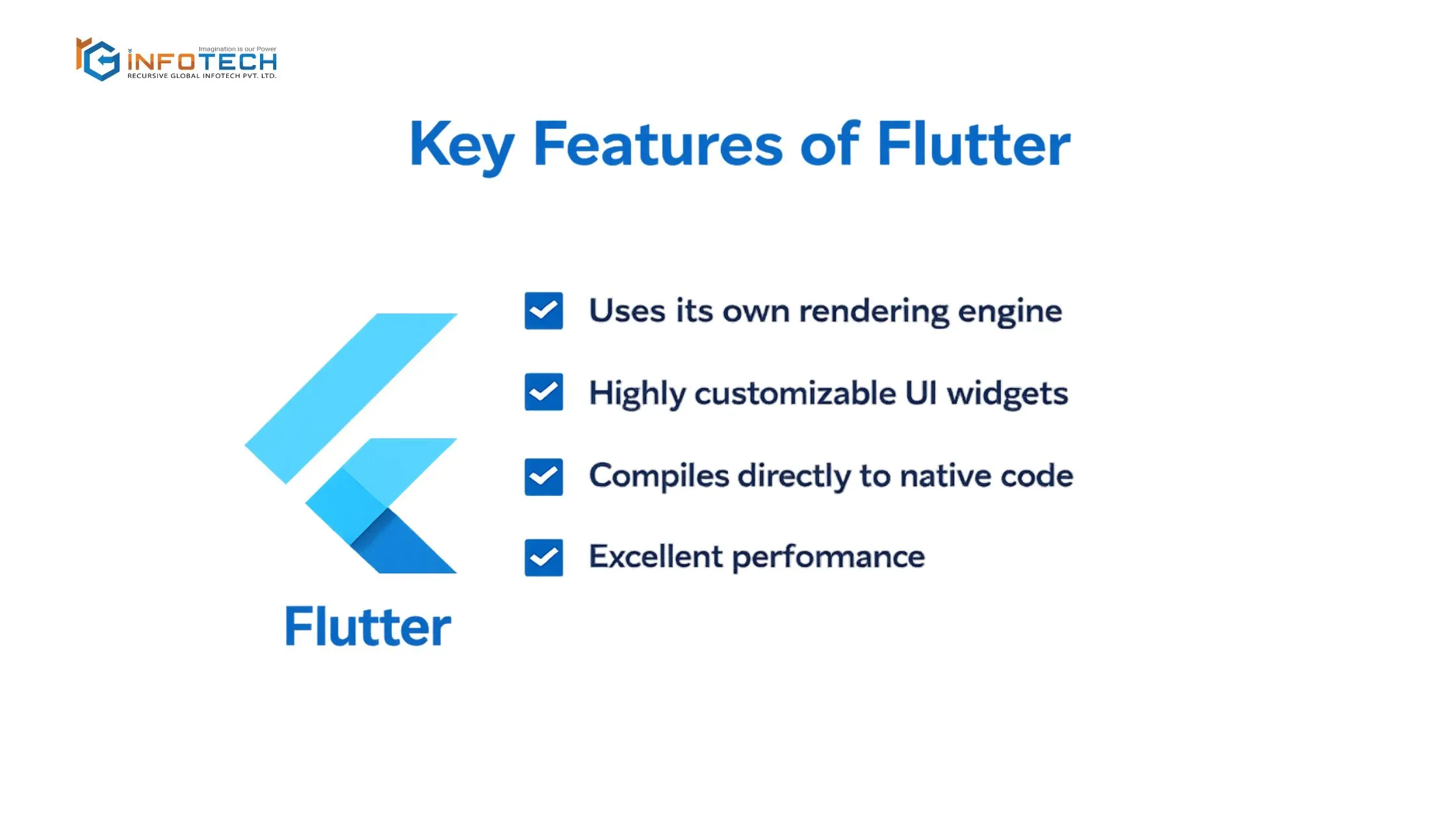
Flutter is a UI toolkit developed by Google. It is based on the Dart programming language. Unlike other frameworks, Flutter does not use web wrappers. It has its own high-performance rendering engine named Impeller, which is used to render every pixel.
Popular Use Cases In The Indian Market
Flutter is the darling of the Indian Fintech and EdTech industry. Applications such as Zerodha, Khatabook, and Google Pay India use Flutter because of its security and buttery-smooth animations.
Why Flutter App Development In India Is Gaining Momentum
Indian developers have accepted Flutter app development because of its outstanding documentation and “Hot Reload” functionality. In cities such as Bangalore and Ahmedabad, the number of Flutter app development India experts has increased by 30% in the past year.
Overview of React Native App Development
React Native app development has been a favorite among developers for creating cross-platform mobile apps for the past few years, especially among those who deal with web technologies.
What is React Native?
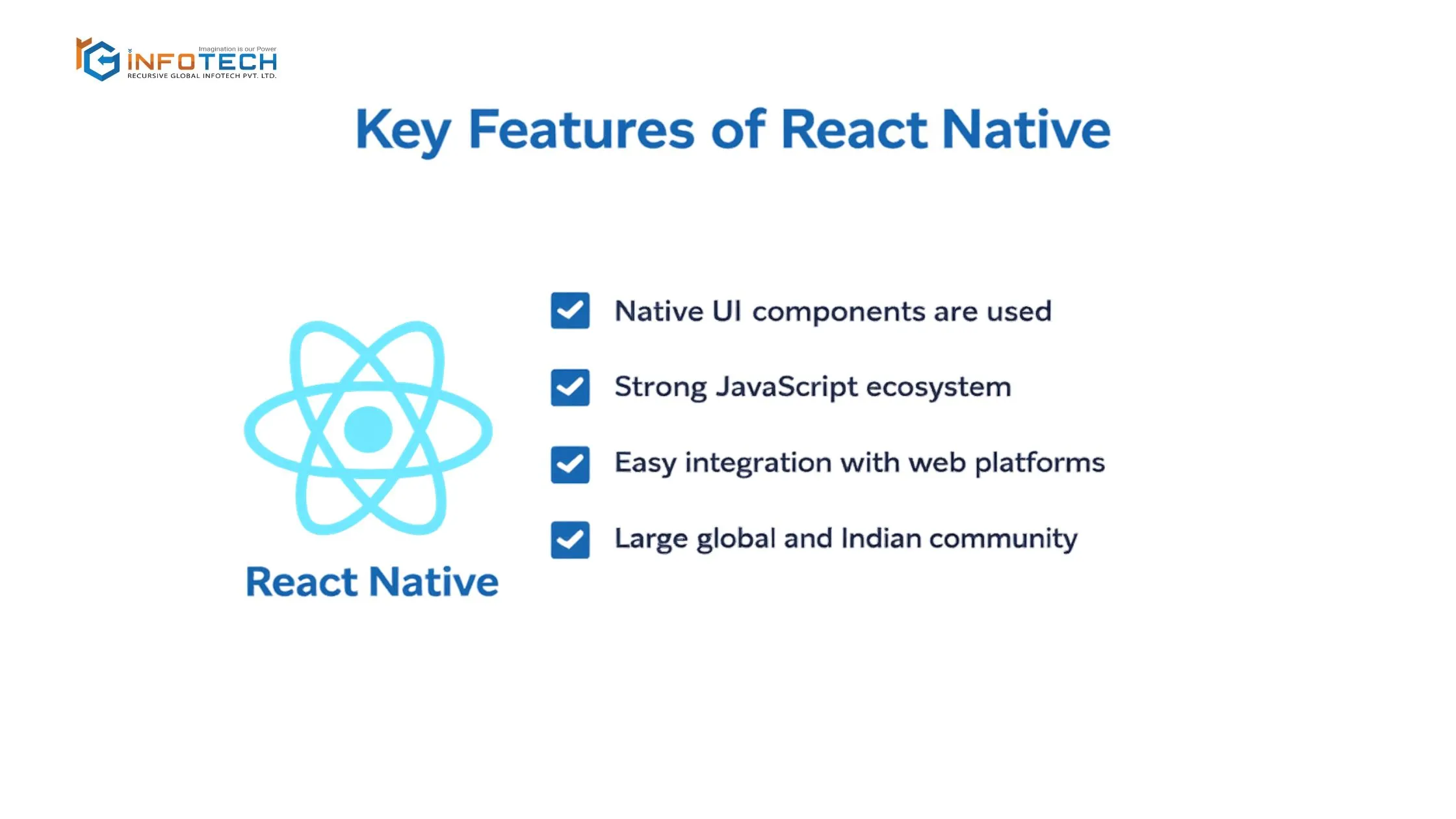
React Native is a mobile app development framework developed by Meta that enables developers to build mobile apps using JavaScript and React. It has been the driving force behind the mobile web revolution for almost a decade.
Popular Apps Built Using React Native:
Since India has a huge talent pool of web developers who are already familiar with React, the switch to mobile is extremely smooth.
Big players like Flipkart, Zomato, and Myntra are using React Native to ensure that their web and mobile teams are always in sync.
Tip:
According to the different learning about both frameworks, in terms of raw speed, Flutter always comes out on top. This is because Flutter compiles its app using AOT (Ahead-of-Time) compilation, which results in a faster-starting app.
However, React Native has closed the gap with its “New Architecture,” which makes it “fast enough” for 95% of business use cases.
Flutter vs React Native: Main Differences
When it comes to cross-platform mobile app development, Flutter and React Native are the two most popular frameworks that are being used by businesses in India.
Feature
Flutter
React Native
Developed By
Google
Meta (Facebook)
Programming Language
Dart
JavaScript
App Type
Cross-platform
Cross-platform
Performance
Near-native
Near-native
Popularity in India
Rapidly growing
Highly popular
Both of these frameworks enable developers to develop apps for both Android and iOS platforms using a single codebase, but they are quite different from each other in terms of performance, cost, development process, and requirements.
Flutter vs React Native Performance Comparison
Performance is one of the most important points when comparing Flutter and React Native.
Flutter is capable of compiling directly to native machine code and has its own rendering engine. This leads to smooth animations and better performance, even on mid-range devices that are commonly used in India.
React Native has a JavaScript bridge that talks to native components, which sometimes leads to performance bottlenecks in complex apps.
As per the Flutter vs React Native performance, Flutter wins this. Flutter performs better and more consistently, especially when it comes to complex UIs.
Factor
Flutter
React Native
Performance
Top-tier (Direct GPU rendering)
High (Native-mapped components)
UI/UX
Pixel-perfect consistency
Native look and feel
Language
Dart (Structured & Type-safe)
JavaScript/TypeScript (Universal)
Talent Pool
Specialist & Growing
Massive & Easy to hire
UI & User Experience
User interface is an important factor in user engagement.
Flutter provides fully customizable widgets, ensuring the same user interface on Android and iOS.
React Native uses platform-specific user interface components, which can work differently on different devices.
As per the UI/UX comparison, Flutter wins this. It is best suited for apps where UI/UX is of utmost importance.
Development Speed
Both frameworks are intended to accelerate development.
Flutter has a comprehensive set of widgets and hot reload, making it easier for developers to create apps quickly.
React Native also has hot reload and a huge JavaScript ecosystem.
Both frameworks are high-speed. So, both are great for development.
Language
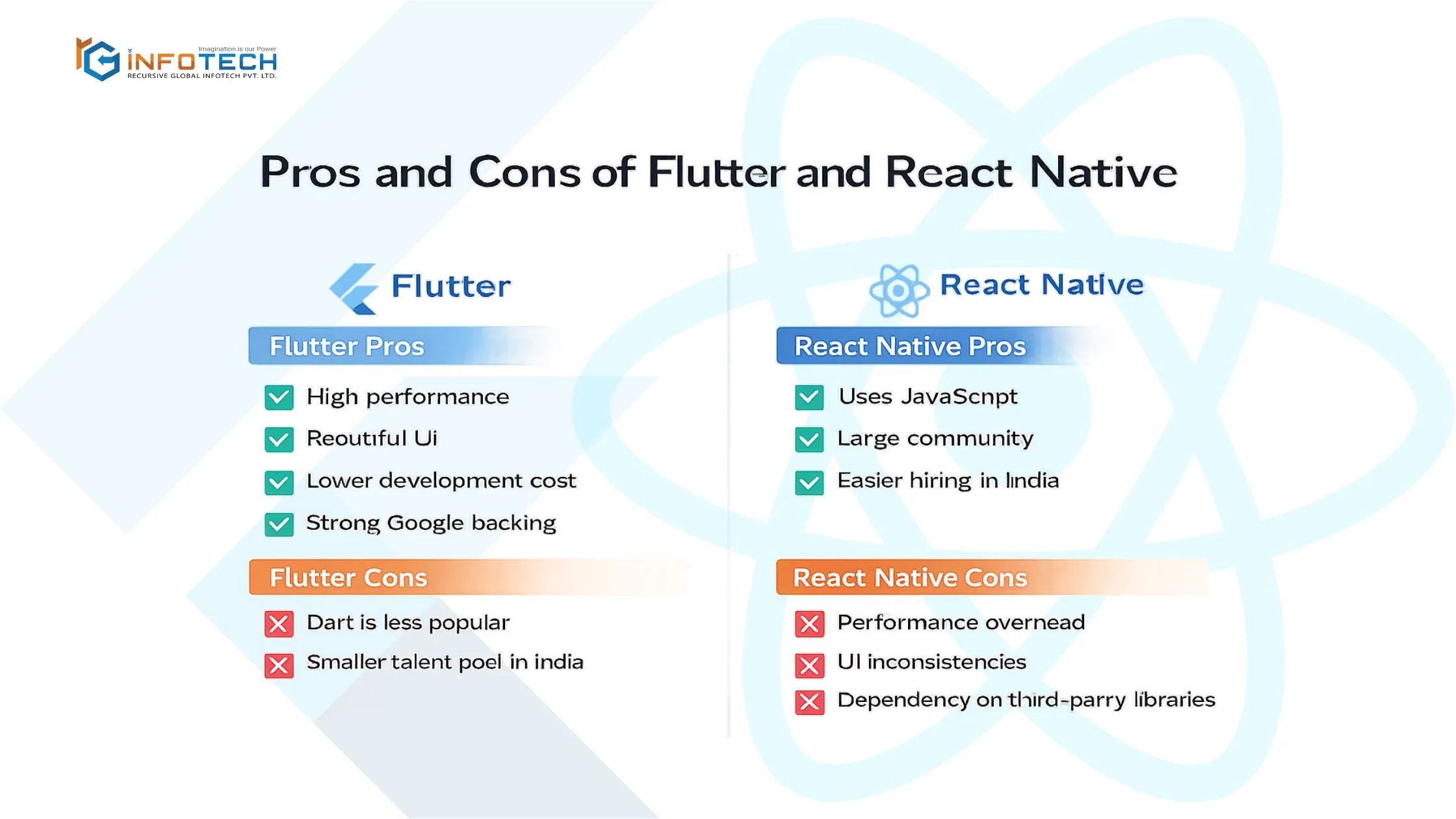
Flutter supports the Dart language, which was specifically developed for this framework. Although it is gaining popularity, it is not as popular in India.
React Native supports well-known JavaScript, and it is easier to find developers who know JavaScript and can be used for web-based projects.
Talent Pool
It is becoming easier to find qualified Flutter developers in India, especially in technology hubs such as Bangalore, Pune, and Hyderabad, although the talent pool is smaller compared to React Native.
One of the advantages of React Native is that it has a large pool of JavaScript developers, which makes it easier to hire and build a team.
Flutter vs React Native Cost in India
When companies look for Flutter vs React Native cost in India, they are essentially looking for an answer to this simple question:
What framework will give me the best app for the lowest cost possible in India?
The development cost of an app in India may vary from ₹5 Lakhs to ₹25 Lakhs+, depending on the complexity.
Cost Factor
Flutter App Development
React Native App Development
Basic App Cost
₹3 – ₹5 lakh
₹4 – ₹6 lakh
Mid-Level App Cost
₹5 – ₹14 lakh
₹6 – ₹16 lakh
Complex / Enterprise App Cost
₹15 – ₹25 lakh+
₹16 – ₹28 lakh+
Average Hourly Developer Rate
₹800 – ₹2,000/hr
₹800 – ₹1,800/hr
Development Speed
Faster (rich widgets, single UI layer)
Fast (may need extra libraries)
UI Customization Cost
Lower
Moderate
Third-Party Dependency Cost
Low
Moderate to High
Maintenance Cost
Lower
Moderate
Hiring Cost in India
Moderate
Lower
Flexible for Cost-Sensitive Projects
Yes
Depends
Flutter: May have a slightly higher development cost due to the need for specialized developers in Dart. Flutter provides a better long-term ROI for high-performance applications since it involves less platform-specific maintenance.
React Native: It may be cheaper to develop in India because of the availability of developers. React Native provides a better short-term ROI for startups requiring an MVP (Minimum Viable Product) in a short period.
When it comes to Flutter vs React Native cost comparison in India, Flutter is often more cost-effective because of the reduced development time and lower maintenance costs. React Native is still a good choice for companies that value ease of hiring and scalability.
Ready to Build Your Next Mobile App?
Collaborate with RG Infotech to create high-performance, budget-friendly cross-platform apps using Flutter or React Native. Let’s turn your vision into reality—faster, smarter, and scalable for the Indian market.
Why Flutter Is Often Cheaper Than React Native in India
When it comes to the cost comparison between Flutter vs React Native in India, Flutter is more economical, not because the developers are less expensive, but because development is faster and maintenance is easier.
- Faster Development Lowers Cost
- Less Platform-Specific Work
- Lower UI & Maintenance Costs
- Better Productivity per Developer
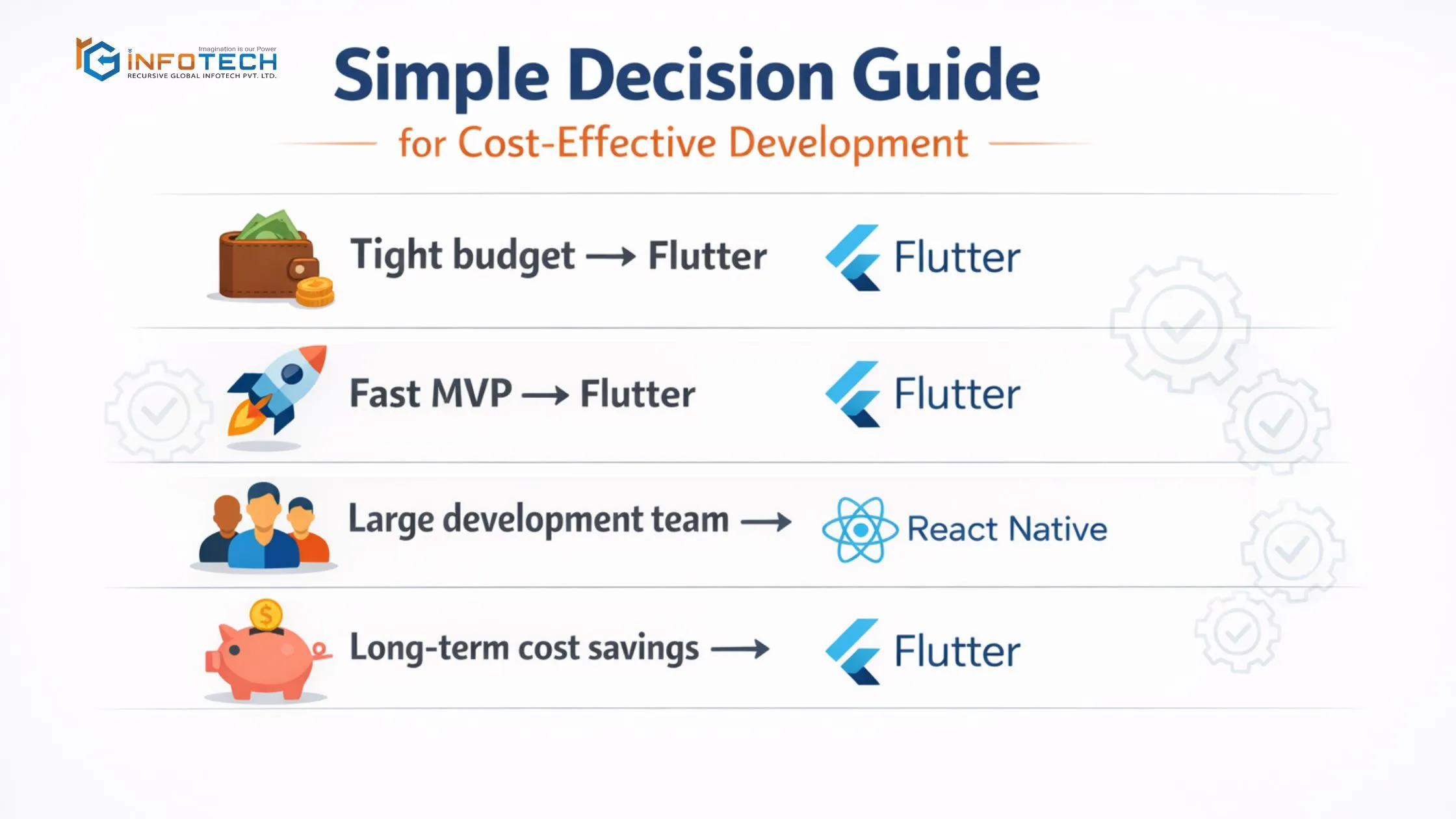
How RG Infotech Can Help You Decide Between Flutter and React Native
Selecting the right framework is essential for cost-effectiveness, performance, and scalability. At RG Infotech, we help Indian businesses make the right decision:
- Business Goals First: We assess your project requirements and target audience to suggest the best framework for you.
- Expert Technical Advice: Our experts assess performance, UI/UX, and integration requirements.
- Cost & Time Analysis: We give you accurate information on development cost, maintenance, and ROI.
- Talent & Resource Planning: We assist you in utilizing the right developers for quick development.
- End-to-End Support: From choosing the framework to deployment and maintenance, we will make sure your app is a success.
Conclusion
Selecting the best cross-platform framework in India can be the deciding factor in your mobile application project. Both Flutter and React Native possess their own advantages:
Flutter provides fast development, beautiful UI, low maintenance, and cost-effectiveness, which makes it suitable for startups in India.
React Native is ideal for enterprises that have massive JavaScript teams and projects that need rapid scaling of teams.
Ultimately, the decision on which framework to use depends on your project requirements, budget, timeline, and team expertise.
With the right guidance from RG Infotech, Indian businesses can make the right choice regarding which framework will give them maximum performance, ROI, and scalability in 2026 and beyond.