Summary:
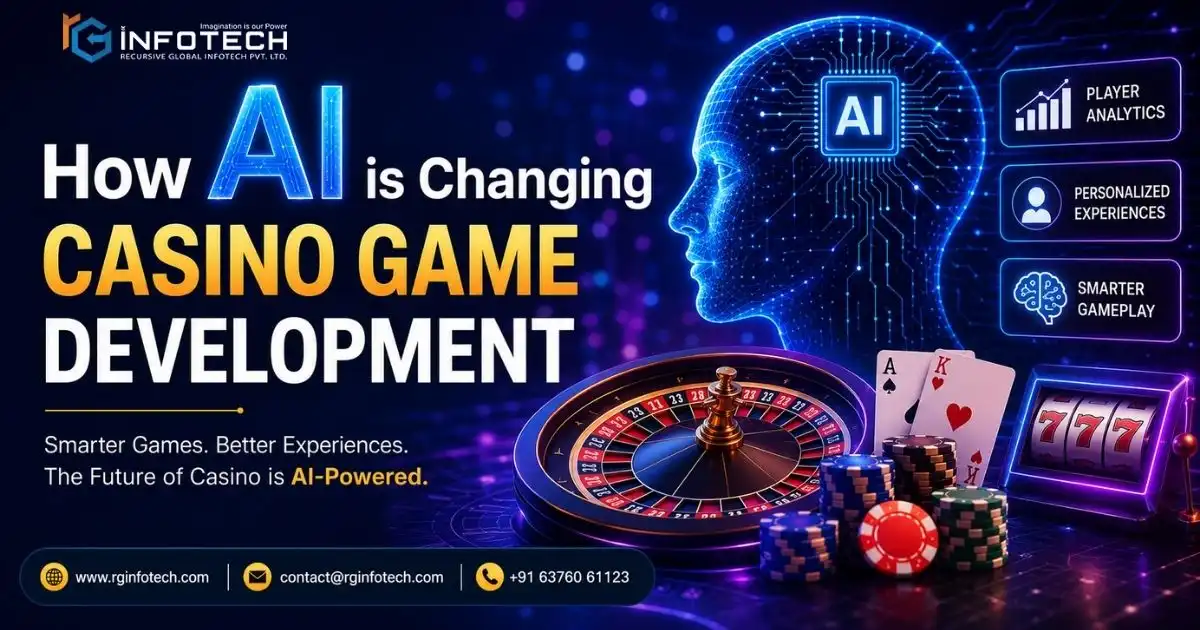
AI is changing how casino games are developed because it enables developers to build gaming experiences that are personalized and more efficient. While creating games, optimizing gameplay, or even testing the game mechanics, AI has become a significant tool in development. In this blog, we will look at how AI is changing the casino gaming industry and what its impact on the industry could be.
The use of AI in casino game development is becoming an important part of how modern casino games are designed, built, tested, rolled out, optimized, and experienced in the iGaming industry.
AI is increasingly finding its place in the iGaming technology stack, with everything from game design, quality assurance, analytics, personalization, fraud detection, and responsible gaming falling under its purview.
However, the most important purpose of using AI is assisting development teams in decision-making, automating routine tasks, recognizing patterns in huge amounts of data, and providing personalized gaming experiences without giving any control over game mechanics and regulations to AI.
Continue reading to see how the best AI company specializing in casino game development can shape the future experience of the coming new players in the iGaming industry.
Key Takeaways:
- AI could create a 20–45% productivity impact on current annual spending in software engineering.
- AI is moving from experimentation toward real-world gaming applications.
- Responsible AI needs to be part of casino game development from the beginning.
- AI can help development teams work faster. AI can improve casino development beyond coding.
- AI can support gambling game development, including game design, menus, avatars, code checking, balancing, and identifying potential loopholes.
- GitHub research found that 85% of developers reported feeling more confident in their code quality when using Copilot.
Here, we will analyze how AI technology influences casino game development in 2026, the value of the latest technology in gaming, its drawbacks, and possible developments of AI gambling in the future.
What is AI in Casino Game Development?
AI is the foremost reason for player engagement and retention in the game. Artificial intelligence in casino game development is about applying AI chatbots, responsible gaming, and machine learning technologies across different phases of AI game development.
Based on these advancements, some of the applications and web platforms of AI must include:
- Developing gaming concepts and features
- Behavior analysis
- Improving games with AI casino game design
- Art and asset production
- Software engineering
- Quality assurance and testing
- Recommendations and personalization
- Detection of fraud and anomalies
- Support and customer service
- Analysis and forecasting
- Gaming responsibly
- Localization of content
A gaming company can incorporate AI in iGaming to enhance the overall gaming experience, analytical tools, development, and management system, although the mathematics of the game, along with its rules and random number generation process, is still regulated by specific requirements.
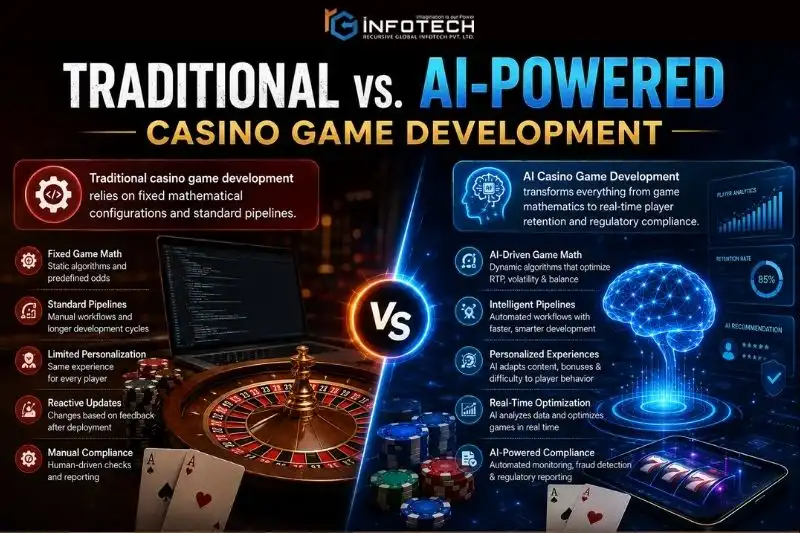
The Evolution of Traditional vs. AI-Powered Casino Games
In conventional casino games, there were always pre-set rules, mathematical models, player experience standards, and manual development process management. These traditional principles are still the key foundations for regulated casino gaming, but now AI changes the game development paradigm significantly.
This is not merely about “old” versus “new” casino games. Rather, there is a shift within the industry toward moving away from rigid, rules-based games and toward a more data-based gaming ecosystem, while still keeping the game logic itself under proper control.
Traditional Casino Games: A Fixed and Structured Approach
Casino-style games are typically structured around mathematics, game logic, interface, and player journey, which are predefined.
For instance, in a traditional digital slot game, there would be:
- A predetermined mathematical model
- Predefined win lines or combinations
- Game logic
- A random number generation system certified when needed
- Visual and audio assets
- An almost constant user interface
- Manual testing procedures
AI-Powered Casino Games: A More Data-Driven Ecosystem
AI for online casino games entails the involvement of machine learning, AI chatbots, and search personalisation in selected areas of development to enhance the player experience ecosystem.
AI may be used for:
- Concept generation
- Behavioral analytics
- Testing
- Personalization
- Recommendation engine
- Fraud and anomaly detection
- Analytics
- Localization
- Customer support
- Automation
AI vs Traditional Casino Game Development
Area
Traditional Approach
AI-Powered Approach
Game development
Primarily manual workflows
AI-assisted workflows
Game ideation Human
Research and brainstorming
AI-assisted research and ideation
Player analysis
Historical/manual analysis
Machine-learning-assisted analysis
Personalization
Predefined rules
AI personalization in casino games gives data-driven recommendations
AI game testing
Manual and automated test cases
AI-assisted testing and anomaly detection
Content creation
Manual production
AI-assisted content and asset ideation
Analytics
Periodic reporting
Advanced and predictive analysis
Fraud detection
Rule-based systems
Pattern and anomaly detection
Localization
Manual translation workflows
AI-assisted localization
Optimization
Manual analysis
AI-assisted insights and forecasting
The key is that AI doesn’t automatically take the place of traditional technology used for casino games.
AI technology in casino gaming could improve the process of developing and running the games.
How AI is Changing Casino Game Development (Trends & Tech)
AI has already evolved from being a test tool to becoming a part of the overall casino game development process. Now, developers can take advantage of AI and machine learning technologies for faster prototyping, player analysis, improved testing, live-dealing, risk detection, and product decisions based on data.
The key shift is not in AI replacing existing casino game technology. The key shift is in adding an intelligence layer to the ecosystem of development and players’ experience.
Below are the key AI trends influencing casino game development in 2026.
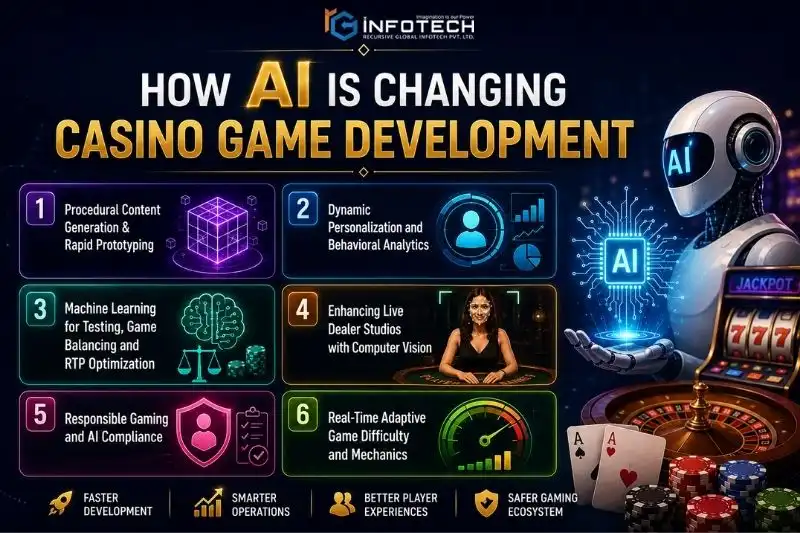
1. Procedural Content Generation & Rapid Prototyping
Creation of a new casino game usually implies a lot of work on the part of the developers in such areas as concept creation, mathematics, game mechanics, art, programming, audio, and user interface/user experience.
AI-assisted procedural content generation may assist developers in trying out their concepts faster. In such cases, the game development studio might employ AI to develop a number of initial concepts for a new slot theme and analyze them using market research, technology evaluation, branding requirements, and player expectations.
The aim here is not to release games that have been developed by AI without further review. The goal is to bring AI closer to the idea-prototype-human process. This helps designers and developers to test out a greater number of concepts.
2. Dynamic Personalization and Behavioral Analytics
The casino platform produces large quantities of behavioral data.
AI and machine-learning algorithms can assist the development and product teams in analyzing this data to gain insight into how various users interact with their games.
The use cases are diverse:
- Player segmentation
- Game suggestions
- Content personalization
- Session analytics
- Feature usage analytics
- Churn analytics
- Detection of behavior patterns
- Optimization of game discovery
- Classic solutions are usually rule-based to a great extent.
For instance, an AI-supported recommendation engine may find connections between game preference, past interaction, session activity, and any other permissible signals to figure out which games or content might be more appropriate for a certain player.
It will help make the experience more personalized without forcing the developers to craft rules for each possible player group by hand. Nonetheless, personalization needs to be done properly.
There is also a need to consider the player’s privacy, data protection, responsible gaming, transparency, and regulatory requirements for a safer gaming ecosystem.
3. Machine Learning for Testing, Game Balancing and RTP Optimization
Finding balance in a math model of a casino game is quite an intricate art form. Too much volatility may drive off casual gamers, whereas frequent payouts may be boring for gamblers.
Simulated AI Game Testing: Developers apply artificial intelligence (AI) agents to perform millions of simulated spin cycles in just a few minutes. They are testing the math model to find any possible loopholes, to confirm the accuracy of Return to Player (RTP), and to meet house edge requirements in the long run.
Volatility Mapping: The machine learning technique is used for tuning up the frequency of hits and payout patterns.
4. Enhancing Live Dealer Studios with Computer Vision
Live table games such as blackjack, roulette, and game shows rely on perfect conversion from physical form into digital form.
Real-time Monitoring: Computer vision and artificial intelligence-based optical character recognition (OCR) technology monitor physical card decks, roulette wheel spins, and dice throws in real time.
Error Prevention: AI technology serves as a backup system in live dealer studios that warns human dealers about potential errors before they become part of the gaming session.
5. Responsible Gaming and AI Compliance
With regulatory oversight becoming more stringent in the international iGaming space, AI technology has emerged as a means to meet regulatory requirements and protect players.
Preemptive Action: AI-based systems analyze playing behavior for signs that could suggest risk factors such as chasing losses and frequent depositing, which makes it possible for the company to initiate an automated safer gambling response.
AI-Based Regulatory Audit: Compliance software checks game programming code as well as RNG output according to strict regulatory guidelines.
6. Real-Time Adaptive Game Difficulty and Mechanics
Going beyond fixed setups, modern studios employ AI to generate adaptive gaming environments that automatically balance game mechanics and pacing on the go.
Flow State Optimization: Dynamic Difficulty Adjustment algorithms analyze session statistics, including winning frequency and betting amounts, and ensure the maintenance of player engagement without changing the certified math models.
Churn Prevention: If dry runs become too long and may lead to session dropouts at the beginning of a gaming session, AI can adjust the secondary mechanics, for example, add unique bonus generators or pacing changes, to engage players.
Staying Compliant: Such systems solely deal with the perceptual difficulty and entertainment value, leaving the RNG and RTP untouched.
These are the key trends that help in striking the balance between originality and efficiency. To get to know in detail about the Top 10 Latest Trends in Online Casino Game Development in 2026, check our esteemed guide on the same.
Create Smart Casino Games with Artificial Intelligence
Want to add innovation using artificial intelligence in your casino gaming platform? RG Infotech supports business ventures in developing smart and interactive games for casinos using artificial intelligence and other solutions for game development.
Let’s develop your casino game with artificial intelligence. Talk to us today.
Benefits of AI-driven Casino Game Development
AI technology has revolutionized the way game development companies work, going well past mere automation. For game developers operating in an intense and competitive iGaming environment, AI can act as a strong amplifier of their abilities.
Massive Decrease in Time-to-Market: Procedural toolsets and generative asset creation allow a drastic decrease in time needed for concepts, graphics rendering, and prototypes.
Cost Efficiency: Machine learning in casino games and automatic game prototyping help in reducing overhead costs associated with traditional manual QA and graphic design cycles.
Improved Data-Driven Iteration: Rather than simply guessing, developers use prediction models to understand which themes, mechanics, and volatility cycles work best with target demographics prior to release.
Cross-Platform Optimization: With the help of artificial intelligence profiling, video games will automatically optimize their performance, layout, and memory use on all mobile platforms and browsers with poor bandwidth.
The Role of AI in Security, Fairness, and Responsible Gambling
In the iGaming industry, where trust is currency, security and fairness should be taken care of as a priority. Since real money is on the line, integrity and compliance are a must, and here is where AI becomes indispensable.
Absolute Fairness & Random Number Generator Verification: Automated machine learning scripts test millions of simultaneous simulation sessions to confirm the correctness of the math distribution. This means that RTP rates correspond exactly to the standards.
Modern Proactive Responsible Gaming (RG) AI: Today’s AI solutions are no longer limited to reactive approaches but include identifying nuanced behavioral cues such as betting size spikes, loss-chasing, or unusual gaming session times that could result in proactive prompts or mandatory cooling-off periods.
Fraud Prevention and Threat Detection: Computer vision and anomaly detection technology guard live dealer streams and multi-player game tables against card counting, automation hacks, and account takeovers.
Challenges of Using AI in Casino Game Development
Even with its numerous benefits, the integration of artificial intelligence in the construction of casino games presents its own challenges that need to be handled with care.
Data Privacy: As a result of handling sensitive information regarding player behavior, there is a need to adhere to various privacy laws, such as GDPR, while using artificial intelligence.
Security Issues: Connecting with third-party AI endpoints or machine learning pipelines on the cloud will open up attack vectors for malicious actors who seek to attack or use the game server as well as its logic.
Technical Difficulty: Combining intricate neural networks or procedural generation systems with existing highly audited immutable casino systems will require rare engineering expertise.
Bias Issues: If the dataset used for training is biased toward a particular demographic group, the AI personalization system may end up wrongly classifying user segments or creating game loop issues.
Regulatory compliance: Regulatory bodies in various regions monitor dynamic algorithms very carefully. Establishing the fact that the AI software modifies only the perception-related part of RNG algorithms but not the mathematics behind the algorithms is difficult.
Implementation costs: Upfront costs associated with creating one’s own machine learning framework, purchasing proprietary models, and employing experienced engineers could be a burden for a small studio.
All these challenges need to be addressed properly; you can partner with RG Infotech, which is the best AI casino game development company for delivering faster and more immersive online casino games.
What is The Future of AI in Casino Game Development?
The more we explore the world of the digital age, the more the integration of artificial intelligence in casino gaming will help to change the very borders of entertainment interaction.
Emotional AI & Hyper-Personalization: Games of the future will make use of ambient information and micro-expressions to adjust the game speed and visual-audio context depending on your mood.
World Building through Generative AI: In real-time, generative AI will facilitate players to design their own slot backgrounds or bonuses during game sessions.
Deeper Integration of AR and VR via AI: The future of extended reality will make extensive use of AI in optimizing the rendering process and delivering a photorealistic 3D virtual casino experience on user devices.
How To Choose an AI Casino Game Development Company
Choosing a good studio to work with is the key factor for an operator when developing new, innovative, AI-powered content. Consider the following:
Proven Record of Regulatory Compliance: Choose a partner that has experience developing games that were certified by independent testing labs such as eCOGRA and GLI.
AI Skills Proven: Look at what they have done in terms of real application of machine learning, procedural generation, and UI optimizations instead of just fancy buzzwords.
Strong Security Framework: Check to see that they code securely, encrypt data, and build their servers properly to prevent any security risks.
End-to-End Services: The best company would do all of the math modeling, HTML5/WebGL rendering, and anything else needed after launch.
Make Your Casino Game Concept Come to Life With the Help of Artificial Intelligence
Do you have a unique idea for a casino game? Work together with us to develop AI-based casino games tailored specifically to your business needs and objectives.
Contact our casino game development specialists now and start creating your AI-based game solution!
Conclusion
AI in casino game development is no longer just a fancy idea of how games could be created in the future; it is the driving force behind the new generation of fast, secure, and personalized casino gaming solutions.
Despite the fact that developers face unique challenges related to data security, regulatory compliance, and technology integration, the benefits are enormous.
The studios that manage to effectively use AI for optimization of math models, enhance live dealers’ security, and optimize the development process will eventually catch up with the interests of today’s players and win in the market.
Get in touch with our expert team to develop efficient AI casino software for your gaming business.