Summary:
This Travel App Development Guide describes ways for creating a viable travel app using must-have travel app features such as booking systems, GPS, payment systems, a recommendation engine based on artificial intelligence, and real-time data updates.
The guide discusses different types of apps, the app development process, the technology stack, costs, monetization techniques, and trends in the travel industry.
The travel app development guide is rapidly becoming essential for travel business owners looking to capture the growing digital travel market in 2026.
The global travel industry has seen a rise in smartphone use, with people booking flights, making hotel reservations, managing itineraries, and planning their travels.
Travel business owners are investing heavily in AI-powered travel app development and user-centric mobile applications to stay competitive in the travel industry.
Many people still rely on outdated travel apps that are slow, difficult to navigate, and lack in providing a personalized experience to their customers.
As the demand for digital transformation is growing, businesses are investing in advanced travel mobile app development to improve customer experience and generate revenue.
Modern travellers expect an easy booking system that traditional applications fail to provide. Poor performance often leads to lower customer retention and missed booking opportunities.
Travel app development company in India makes a difference by creating a next-generation app for modern travelers. This guide will provide you with knowledge about travel apps development in detail.
Key Takeaways:
The global market is valued at $1 trillion in 2025.
The global travel market is going to reach around $3.5 trillion by 2033,
Only 70% travellers use one travel app for booking, around 40% use an all-in-one booking app from mobile devices.
Around 52% of the online travel bookings are done by mobile apps.
What is Travel App Development?
Travel app development is a process of creating mobile and web applications that help travellers to plan, manage, and enhance their travel experience digitally.
These apps include features like flight booking integration, hotel reservation systems, itinerary planning, navigation, real-time updates, digital payments, and AI-based travel recommendations.
Recently, these advanced travel apps have been designed to make traveling faster, smarter, and more personalized for users.
Nowadays, travellers expect convenience, speed, and a smooth digital experience. Travel apps have completely changed the tourism industry by making it more personalised and hassle-free.
Ready to Create Your Travel Application?
Create a highly scalable travel app with efficient booking facilities, AI-driven suggestions, live tracking, and superior user experience.
No matter whether you require a basic MVP model or a secure travel app development solution, our skilled developers will help bring your app concept to reality through a mobile travel solution.
Top Travel App Development Trends in 2026
The mobile app solutions for the travel industry are shaped by AI, immersive experiences, and sustainable tourism.
Now, travellers are not looking for basic booking apps; they expect a more advanced personalised digital experience. Here are the most travel app development trends transforming the travel tech industry in 2026:
Agentic AI & Hyper-Personalization
AI travel planner app development has gone beyond simple recommendations. Travellers now use Agentic AI that plans, manages, and optimizes entire trips.
These AI-powered travel assistants help travellers in creating itineraries automatically, suggesting destinations based on user behaviour, handling booking modifications, syncing it with calendars, rebooking in case of delays, and sending real-time travel alerts.
AI travel app development creates a zero-touch travel experience that saves travel time in planning and makes more time for enjoying the trip.
Travel Mixology
Travellers use multiple platforms in a single journey. In time to come, travel mixology is going to become a core part of tourism app development. The services they use are:
- Flight booking apps
- Hotel apps
- Cab services
- Maps
- Food delivery
- Activity platforms
AR/VR Experiences
AR and VR have brought about a drastic change in the tourism industry by providing virtual and interactive experiences to tourists.
Through travel apps based on AR and VR technology, tourists have been able to tour destinations and hotels as well as tourist attractions without having to physically visit these places.
For instance, one is able to take a walk around the room in the hotel or visit destinations and tourist attractions using VR or AR, respectively.
This has become an important part of online travel app development due to its competitive nature.
Sustainability Features
The sustainability feature is now considered indispensable when developing modern online booking applications since travelers are increasingly looking for sustainable ways of traveling.
In 2026, the travel app should allow users to travel sustainably and reduce their carbon footprint.
Voice & Multimodal Search
Advanced features such as voice recognition and multimodal search enhance usability because users can use voice to look for destinations or other things.
Travel applications become smart, easy, and quick using this technology.
Contactless & Real-Time Everything
A contemporary traveler demands that everything happens quickly and seamlessly. By 2026, a contactless and real-time approach will become an integral element in travel software development.
Convenience and safety are what travel applications offer to their users.
Blockchain for Secure Payments
The blockchain travel apps give secure and quick digital transactions. In 2026, most travel apps have begun using blockchain technology to ensure secure payments and facilitate cross-border transactions.
Pet-Friendly Travel Tech
The pet-friendly travel technology is fast becoming one of the most prevalent trends within travel application development since many travelers prefer taking their pets with them when traveling. Today, pet-friendly travel apps have been created to facilitate travel for people with pets.
Gen Z-Centric Travel Experiences
The next generation of travelers is reinventing the process of online travel app development through their desire to use mobile, social, and experiential applications. This differs from the previous generation in the way we use conventional apps.
Current travel apps have been built to accommodate Gen Z preferences and behaviors.
To know the latest trends in travel app development, you can check our esteemed blog on Top Travel App Development Trends to get detailed insights.
Types of Travel Apps for Your Business
The tourism industry is experiencing significant changes. Today, business owners have several possibilities for creating their own custom travel apps that fit the needs of customers and the market demands.
From itineraries planning apps to travel super apps, various kinds of travel apps can improve the overall customer experience.
Here is a list of the most common travel app types that businesses may develop in 2026, along with some real-life examples and feature ideas.
Travel Itinerary App Development
Itinerary Planning Apps are useful for managing, organizing, and optimizing one’s travel plans from one app. They facilitate the process of travel planning through scheduling, booking, and giving updates on travel status.
Today’s travelers find such apps convenient to use since they lower the level of travel anxiety. Examples are TripIt and Wanderlog.
Transportation & Hotel Booking App Development
Transportation Booking Applications enable passengers to look up and schedule various means of transportation using one application alone. It makes traveling easy through the seamless planning of flight, cab, train, bus, and multimodal transport bookings.
By 2026, passengers will favor applications that provide real-time information, flexible bookings, and integration of various transportation modes. Examples are Uber, Skyscanner, Rome2Rio, and Trainline.
Tour & Activity Booking Apps
Tour & Activity Booking Apps assist users in discovering and exploring local tours, activities, events, and attractions using their mobile phones.
Unique experience rather than conventional sightseeing is now the priority of modern travelers; hence, Tour & Activity Booking Apps are among the most popular and rapidly growing categories of travel apps. Examples are GetYourGuide, Klook, and Viator.
Travel Expense Tracking + Multi-Currency Apps
Tracking Travel Expenses and Multi-Currency Apps assist travelers in maintaining their budget, keeping track of their expenses, and conducting transactions in foreign currencies effectively while traveling. They come in handy for frequent travelers, digital nomads, business travelers, and group travel.
Contemporary travelers need full financial control when they travel, which includes currency exchange, tracking expenditures, and managing joint payments. Examples are Splitwise, XE Currency, and Revolut.
Super Travel App Development
Next-generation All-in-One Travel Super Apps integrate booking, trip planning, payment processing, and community functionalities into one comprehensive tourism mobile platform.
Users no longer need to open multiple apps for different aspects of their journey; all they need is one app to manage everything from flights, hotels, activities, and directions.
By 2026, this approach will become the most impactful trend in custom travel app development, providing a seamless experience for managing trips and engaging in communities using AI-driven travel app automation. Example: MakeMyTrip, Tripadvisor, Booking.com, etc.
To get into detail about this, check our blog on Top Types of Travel Apps for Your Business Growth.
Must-Have Features in Travel App 2026
By 2026, travel apps are predicted to move beyond being mere booking platforms. Travellers desire intelligent, real-time, personalized, and seamless travel experiences. A good travel app needs to possess not only core functionalities but also advanced AI functionalities.
The following is an outline of critical features that a travel app must have.
Basic Features
User Authentication
User authentication offers secure login services using emails, phones, or social media accounts to ensure data security and a customized travel experience.
Destination Search
Destination search helps travelers to easily locate flights, hotels, and other activities using intelligent filters, maps, and suggestions.
Booking System
The booking system facilitates an easy and immediate booking of flights, hotels, and tours based on live availability and a smooth booking process.
Payment Integration
Payment integration helps facilitate quick payments through UPI, credit cards, and digital wallets.
Maps Integration
Maps integration helps travelers explore destinations and navigate routes, along with discovering nearby destinations.
Advanced / Trending Features
AI Recommendations
Recommendations based on AI take into consideration users’ behavior and preferences, giving a personalized travel app experience and suggestions for destinations, hotels, and activities for better travel experiences.
AR/VR Experience
With AR VR travel app solutions, you can go on virtual tours of hotels and destination previews before making your final bookings.
Voice/Multimodal Search
Using voice-enabled travel apps, commands, and images, people can easily search for their trips.
Real-Time Tracking and Updations
Live flight status tracking helps travelers know in real-time about flights and delays, along with giving necessary updates about their travels.
Predictive Pricing Analytics
Predictive analytics helps the system estimate price changes and suggests the ideal time to book a ticket to save on costs.
Green Tourism Options
Features related to sustainability inform travelers about their carbon footprint and how to have green travel for sustainable tourism.
Offline Mode Access
No internet travel is another important feature that allows travelers to access everything they need without internet connectivity during travel.
Wearable Devices
Wearable devices can be used for integrating applications to receive real-time alerts while traveling.
If you want to know which features are in trend and which ones are essential in custom travel app development, get detailed knowledge in our guide on Top Travel App Features in 2026.
Benefits of Investing in a Travel App
It is no longer just an investment in the travel app development; it has now become one of the key strategies for the growth of a travel agency, startup, or tourist company. The widespread use of smartphones and demand for immediate booking make travel applications indispensable tools for successful businesses.
Increase Customer Loyalty
Spending money on a travel application will increase customer loyalty through the provision of customized services, easy bookings, and round-the-clock assistance, making customers come back for more.
Higher Earnings
The use of a travel application will boost earnings through booking fees, commissions, advertising, and paid premium services, among others.
Lower Operating Expenses
Automating the process of bookings, payments, and customer service management will save the business a lot of time and resources, thereby minimizing operating expenses.
Data Collection for Effective Marketing Strategies
The travel application will help the business gather valuable information from users that can be used in designing effective marketing strategies.
Market Advantage in 2026
Building a good travel application will give the business an edge in the marketplace, considering the level of competition in the digital travel sector in 2026.
Check out our benefits of investing in a travel app development guide to discover how travel apps boost customer engagement, revenue, and user experience.
Travel App Development Process (Step-by-Step)
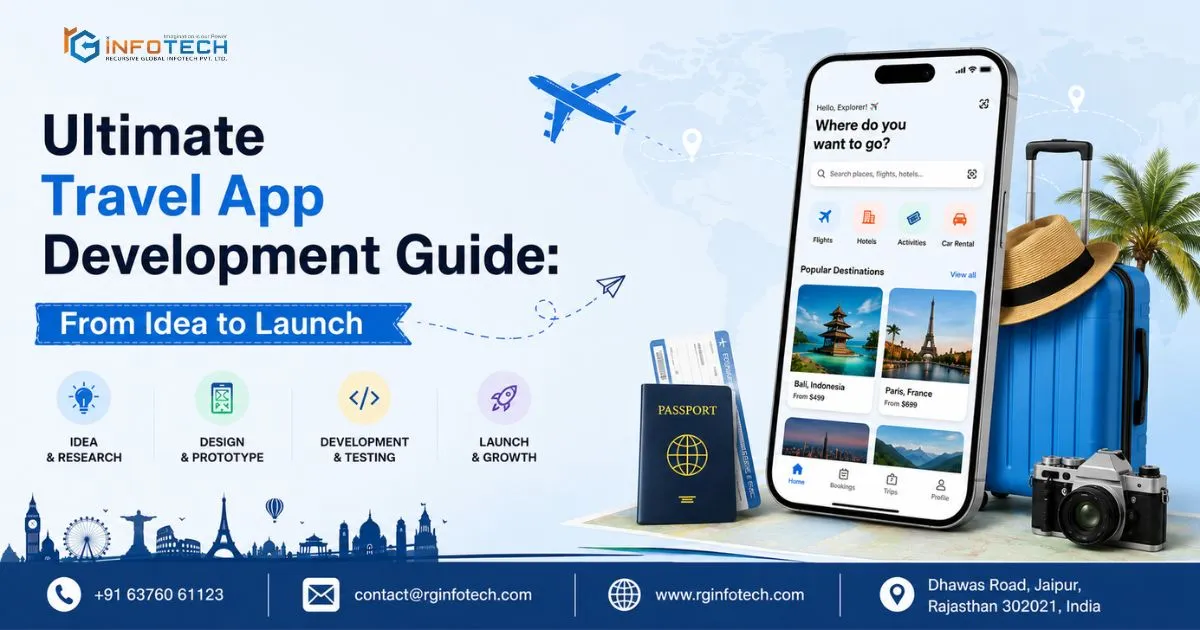
The development of an application for traveling should involve a certain methodology, which includes market research, UI/UX design, and development of the application itself, testing, and optimizing its performance. Here is the travel app development process step by step:
1. Market Research & Competitor Analysis
Market research should be done to identify market demands, user behavior patterns, and competition trends in the tourism industry.
2. Setting Objectives & User Persona Development
Set clear business goals and develop user personas (individuals, business travelers, family, etc.) to determine the features of the application.
3. Interface Design and Prototyping (Figma)
Create intuitive interface designs and user journey maps with tools such as Figma. Emphasize easy navigation, quick booking process, and mobile optimization.
4. Cross-Platform Travel App Development
Develop flexible applications with cross-platform development methodologies for rapid deployment and reduced costs.
Development platforms:
- Flutter / React Native (for custom tourism mobile applications)
- Node.js (for back-end web services)
5. Integrating Modern Technologies into Tech Stack
In the process of travel mobile app development, you must also understand the tech stack used to build a full-fledged product.
To develop a successful application like Booking.com or Airbnb, here is the probable list of tech stacks the travel app development agency will use. The process is to build a full-fledged product. Employ the latest technology for efficiency, scalability, and smart functionality:
- Flutter/React Native (frontend)
- Node.js (backend)
- AWS (cloud-based travel app solutions)
- Firebase (authentication, push notifications, analytics)
- AI & ML technology (personalization, recommendations)
- Google Maps API (navigation & location)
- Payment gateways (Stripe/PayPal/Razorpay)
6. Testing (Quality, Security & Performance)
Carry out testing in the following areas:
- Functional testing
- UI/UX testing
- Performance testing
- Security testing
- Device testing
7. Launch
Release your app to the public. This step involves making it available for download or access through app stores and websites. Promote your travel and hospitality app to reach your target audience using various marketing and promotional strategies.
Often overlooked is the importance of post-launch monitoring and ongoing support to address user concerns, improve app performance, and adapt to changing market trends, ensuring your app’s long-term success.
8. User Feedback
Keep an ear to the ground; what your users say matters. Use their comments and reviews to make your app better by fixing problems and adding the things they ask for. It’s like tailoring your app to fit their needs, which keeps them happy and your app thriving.
9. Maintenance
Regularly update and maintain your app. This includes fixing any bugs or issues that arise, adding new features, and keeping the app compatible with the latest operating systems and devices. Invest in support and maintenance services to ensure a seamless user experience and keep users engaged.
To know the step-by-step process in detail for travel app development, check our insights on How to Create a Travel App from Scratch.
Want to Hire a Reliable Travel App Development Service Provider?
Choose RG Infotech for scalable travel app development services as per your business needs.
- Best Travel App Solutions
- AI & AR/VR Implementation
- Agile App Development
- Post Launch Support
Get In Touch With Us to build an AI-powered travel app in 2026.
Cost of Travel App Development in India 2026
The cost of developing a travel app in India is around ₹5,00,000 to ₹25,00,000, based on the level of sophistication, number of features required, technology stack involved, UI/UX design, integration capabilities, and expertise of the development team.
For a basic travel app with essential features like itineraries, bookings, and user profiles, the travel app development cost estimate is from $25,000 to $50,000.
Mobile application development in India continues to be quite economical due to the availability of talented developers at reasonable rates in comparison to the cost of development in the United States and European countries.
Jaipur, Bangalore, and Pune are some cities with a good development ecosystem at relatively low costs. To get to know in detail the cost of developing a travel app in India, you can check our esteemed guide, Travel App Development Cost in India.
App Complexity
Estimated Cost
Estimated Cost in USD
Timeframe
Basic App
₹5–12 Lakh
$5,000 – $15,000
2–4 Months
Moderate App
₹6–22 Lakh
$6,500 – $23,000
4–7 Months
Advanced App
₹24 Lakh – ₹80 Lakh+
$35,000 – $75,000+
7–12+ Months
Development costs for apps in the travel domain in India for 2026 vary between ₹5 lakh for minimum viable products to 80 lakh+ for enterprise travel app development.
Factors influencing the final cost include:
- Complexity of the app
- Tech stack used
- Quality of design
- Integrations required
- Future maintenance
Why Choose RG Infotech as Your Travel App Development Company?
The process of selecting the best travel app development company is very important while developing an application. RG Infotech offers customized travel application development services for startups, travel agents, and enterprise organizations.
Our agile methodology helps businesses adapt to market changes and user feedback. We develop a wide range of travel applications, including:
- Travel booking apps
- Hotel booking apps
- Tour & itinerary apps
- Vacation rental apps
- AI-powered travel platforms
- Travel management software
Conclusion
This travel app development guide explains that the future of tourism will undoubtedly be influenced by AI-driven travel apps. Companies that develop their travel apps will experience enhanced user engagement, improved profits, and smoother travels.
The main elements that make a good travel app are:
- Effective market research
- User-centric design
- Scalable technology
- Strong IT infrastructure
- Optimization
An effectively planned app will be a lucrative venture and provide smooth sailing to travelers everywhere. Contact us if you are planning to invest in travel app development.