Summary:
Find all information on the development of fintech apps for your mobile device, starting from required functionality, cost estimation, technology stack, security, integrations with financial platforms, regulatory issues, and development process and timeline. Understand how to develop, test, deploy, and scale your fintech mobile application securely.
The Fintech Mobile App Development has revolutionized the way people manage their money, pay for goods and services, obtain financing, invest, insure their assets, and even interact with banks.
Fintech apps range from mobile banking solutions, digital wallets, loans, investments, personal finance tools, and much more.
Key Takeaways:
- Global fintech investment reached $116 billion across 4,719 deals in 2025.
- Global investment in payments reached $19.2 billion across 542 deals in 2025.
- AI is the major trend in Fintech app development.
- The digital payments ecosystem in India reported 20.01 billion UPI transactions in August 2025, worth approximately ₹248.55 trillion.
- RBI reported that UPI as major retail payment option and processed 13.11 billion transactions in FY 2023–24, while digital payments accounted for 99.8% of non-cash retail payment volume during the year.
- Security should be a core part of fintech app development.
However, building a fintech app is much more complicated than creating a simple mobile app. Fintech applications have to consider security, identity authentication, transactions, integration, reliability, regulations, payments, and scalability of the app.
Well, how to develop a fintech app in 2026? What kind of features must it have? What is the best technology stack for a fintech app? How long will the development process take? And which security and compliance requirements does one need to meet?
This guide will help you answer all these questions. So continue reading it.
Get Your Fintech App Developed With RG Infotech
Be it for a digital wallet, payments app, banking application, investment platform, or even an AI-enabled fintech app, we can develop an app that suits your business needs. Book a free consultation with our expert developers to tell us your Fintech App needs and get guidance related to the project.
What is Fintech Mobile App Development?
The development of fintech mobile apps involves the designing, development, testing, protection, and maintenance of mobile apps that offer financial products/services.
Depending on the business model, a fintech app can facilitate:
- Digital payments
- Mobile banking
- Digital wallets
- Money transfer
- Personal finance management
- Investment and wealth management
- Digital loans
- Insurance
- Expenses management
- Buy now, pay later services
- Cryptocurrencies and digital assets
- Financial marketplaces
- Corporate finance and accounting
Unlike any standard customer software, a fintech product will deal with financial information.
This implies that, apart from designing an appealing mobile application interface, the development process entails considerations such as authentication, authorization, data security, transactional integrity, monitoring, third-party integrations, fraud prevention, and regulatory compliance.
The precise requirements vary depending on the nature of the product, legal jurisdiction, financial partners, and offered services.
Different Types of Fintech Mobile App Development
A fintech mobile application is a technological solution for enhancing and simplifying financial operations. Depending on the type of business operation and its specific audience, the application may perform various financial operations, such as payments, lending, investment, or insurance.
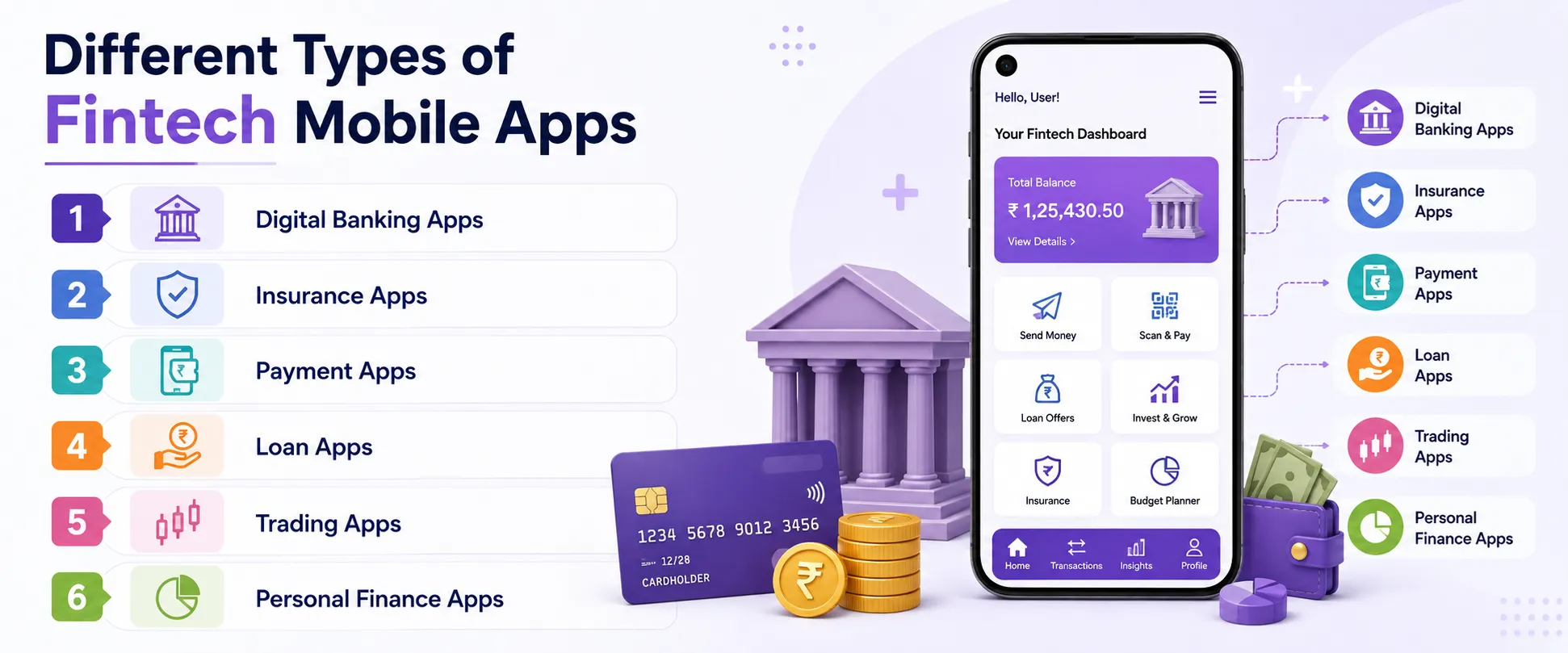
Below are various categories of fintech mobile applications:
1. Digital Banking Apps
The use of digital banking applications enables customers to perform various operations related to banking from their mobile devices without the need for physical banking facilities.
The latest digital banking applications may contain other functions like biometrics, budgeting tools, personalized insights, and instant notifications.
2. Insurance Apps
The use of insurance applications, or insurtech apps, helps consumers keep track of their insurance policies and enables interaction between the consumers and the insurers online.
For instance, the consumer can use the insurance application to view policy details, submit necessary documents for a claim, and monitor the process of filing a claim.
3. Payment and Money Transfer Apps
Money transfer applications make it more convenient for both individuals and business organizations to make transactions in a digital manner.
The issue of security becomes especially significant in such applications due to the processing of financial transactions.
4. Lending and Loan Apps
Loan and lending applications provide the ability to make the loan process fully digital, from the initial application to verification, approval, disbursement, and repayment.
Based on the specific type of product or region, loan applications may also include integration with credit reporting, verification, payment, and risk management services.
Since lending is always an inherently risky financial service that requires compliance, this needs to be considered when designing the application.
5. Investment and Trading Apps
Investment applications help users track their portfolios, while some trading applications provide access to investment/trading services using the smartphone.
Depending on the specific application, users can check out the market data, conduct asset research, place orders, track portfolios, get notifications, and view statements or reports.
6. Personal Finance Management Apps
Personal finance management tools enable users to manage and analyze their finances within one application. Personal finance applications have the capability to collate information related to spending, budgets, savings, bills, and financial goals.
Using proper permissions and privacy settings, sophisticated personal finance apps are capable of using analytics and AI to give spending suggestions.
Key Features for Your Fintech Mobile App Development
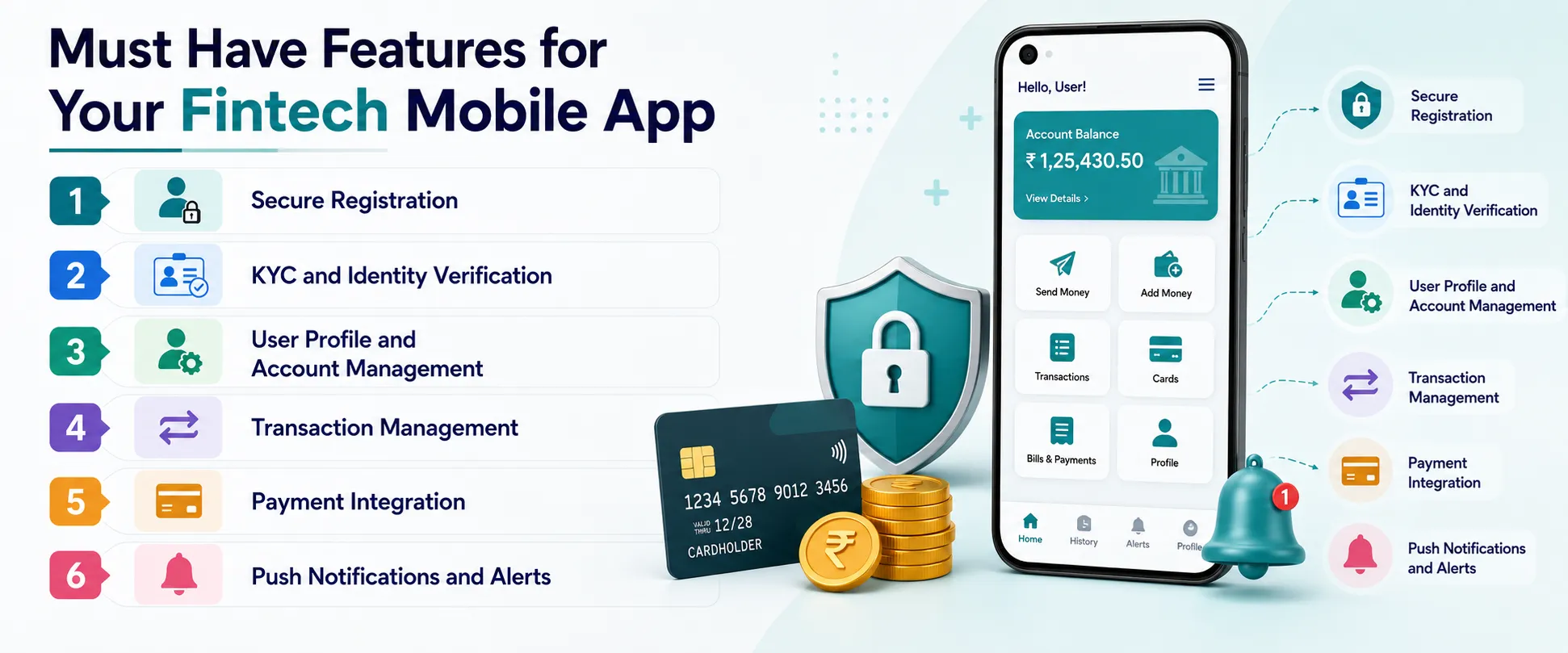
It is not enough for a fintech app to have good UI design. It should guarantee security, reliability, and convenience of performing financial operations without disclosing users’ and transactions’ confidential information.
The below fintech app features constitute the core of these apps. According to the purpose of your app (digital banking, payments, lending, insurance, investment, or personal finance), you may extend its functionality accordingly.
1. Secure Registration and Login
User registration and logging in is the first line of defense of any fintech mobile app. Users need to be able to sign up and log in without endangering account security.
2. KYC and Identity Verification
Know Your Customer (KYC) is an integral part of many finance apps. KYC is used to verify customer identity and satisfy any customer due diligence criteria.
3. User Profile and Account Management
The account management module is used to handle the user’s personal data, financial accounts, security settings, and communication preferences..
Since this information is sensitive in nature, any alteration in critical information about an account should be appropriately authenticated and authorized
4. Transaction Management
Transaction management is an integral part of any fintech application. The user must have complete transparency regarding his financial transactions, and know if they are successful, pending, failed, reversed, or returned.
5. Payment Integration
Integration of payments enables the fintech application to integrate itself with the finance infrastructure needed to enable those transactions that are supported.
There must be an easy way to manage failed, pending, duplicate, reverse, and disputed transactions as well.
6. Push Notifications and Alerts
Push notifications ensure that users remain aware of critical financial and security-related events.
Notifications must not include any unnecessary information regarding financial data while the device is locked or used by another user. Users should be provided with adequate notification controls as well.
Fintech Mobile App Development Trends
Fintech will transition from simple digital payments and mobile banking towards artificial intelligence, embedded finance, real-time payments, open banking, improved fraud protection, and intelligent automation.
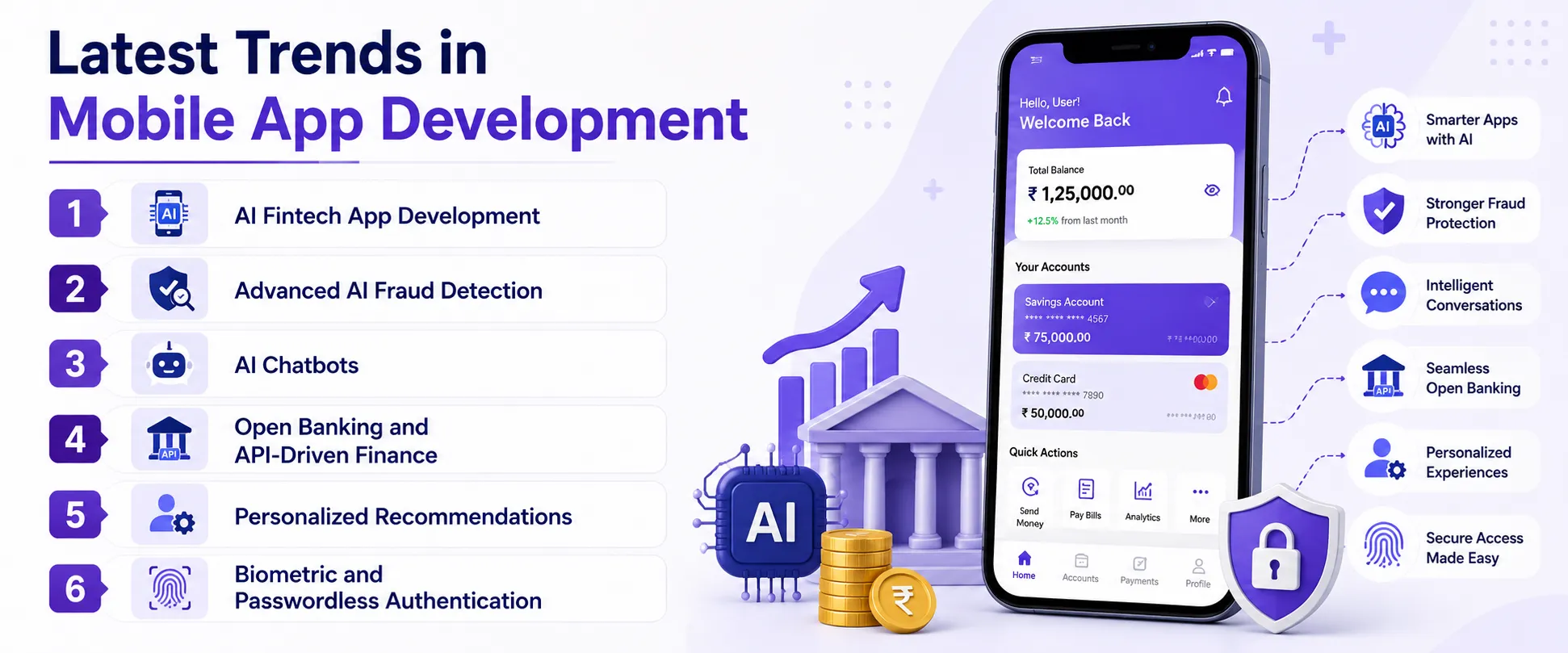
By 2026, more emphasis by fintech companies will be put not only on developing additional functionalities but also on creating safe and reliable financial systems.
AI Fintech App Development
Artificial intelligence has now become an integral component of fintech applications and not just an aspect of support for customers.
Fintech firms are applying artificial intelligence in fraud prevention, underwriting, KYC, compliance monitoring, customer service, financial intelligence, and operational processes.
Advanced AI Fraud Detection and Prevention
With the increase in digital financial transactions, the issue of fraud prevention becomes more and more important.
In Fintech apps, the use of classic approaches combined with AI and machine learning technologies is used to detect suspicious patterns. Another trend is the transition from post-transaction fraud prevention to real-time fraud prevention.
AI Chatbots
AI chatbots have become a key component of mobile application development in fintech, assisting finance companies to give their customers faster and more personalized support.
In contrast to conventional rule-based chatbots, intelligent assistants are able to comprehend natural language queries and generate appropriate answers based on authorized data.
Open Banking and API-Driven Finance
Open banking allows financial apps to integrate with banks and other financial services via APIs and data sharing based on consent. The trend towards open finance extends this to connect financial data beyond bank accounts.
For developers, this means that the API structure, consent management, authentication, security of data, and interoperability must be taken into account from the start.
Personalized Recommendations
Personalized experiences in Fintech apps are becoming more common. Personalization in Fintech apps is becoming more advanced thanks to the use of AI and analytics. Nevertheless, personalization must be executed in an appropriate manner.
Biometric and Passwordless Authentication
Fintech apps are now using various forms of authentication that ensure more safety and convenience.
The goal here is to minimize dependency on passwords and increase safety from account takeover or credential theft.
When there is a high level of risk involved, fintech apps may use more than one factor for authentication.
How to Build a Fintech Mobile App
Building a fintech mobile application is not just about mobile development. It involves integration of financial services that need to incorporate user experience, security architecture, financial integration, regulation, testing, and monitoring.
The systematic fintech app development process allows reducing technical risks, managing costs, and developing a scalable product.
Step 1: Define the fintech product
Begin by properly defining the financial issue your app will address and the customers you would like to serve.
For instance, your app may be a digital wallet, lending site, investing site, and personal finance tool, which will have completely different needs. This is the point where a proper product requirements document (PRD) should be developed.
Step 2: Analyze regulatory requirements
Regulatory and compliance requirements must be addressed before development, since they affect the product design, architecture, data handling, KYC, payments, and operations.
In terms of the product and market, you may have to analyze:
- KYC requirements
- AML requirements
- Payment requirements
- Privacy and data protection requirements
- PCI DSS requirements when appropriate
- Licensing requirements
- Consumer protection requirements
- Data retention requirements
- Transaction monitoring requirements
Your obligations will vary based on the financial product, the jurisdiction, business model, and regulatory framework.
Partner with professional lawyers and compliance experts to identify relevant requirements for your product.
Step 3: Define the MVP
Do not try to implement all possible fintech features in the initial release.
Identify what the minimum set of features will be for validation of your core proposition of the business.
Typically, a fintech MVP would contain:
- Secure registration
- KYC
- User profile
- Account/wallet
- Payments
- Transaction history
- Notifications
- Minimal admin panel
- Customer service
A well-defined MVP can help in maintaining cost-effectiveness while developing the fintech application and also help businesses get real user feedback before scaling up.
Step 4: Design UX/UI
FinTech applications must ensure that all transactions are simple and easy to conduct but hard to conduct incorrectly.
A user must always be sure about the transaction performed, the amount of money in question, and whether the transaction was successful or not.
Fintech app security should also be considered from the point of view of the user experience (UX). Sensitive actions could be verified.
Step 5: Develop the application
After finalizing the product requirements and designs, the process of development can start. The fintech technology stack can be composed of native technologies like Swift and Kotlin or cross-platform technologies like Flutter and React Native, depending on the requirements of the project.
Step 6: Integrate financial services
Integrate the fintech application with financial service and API integrations that is needed for its basic functionality. This may involve a payment gateway, bank API, Know Your Customer services and APIs, open banking APIs, a fraud detection system, and financial data services.
Integrations need to be done by implementing secure authentication, encryption of data transfer, appropriate error handling, and transaction processing. Considerations before settling on a particular service provider include security issues, reliability of the APIs, cost, documentation, geographic reach, and compliance needs.
Step 7: Test the application
Testing is crucial since financial technology apps deal with sensitive financial information. Test the app for functionality, security, performance, integration, and usability.
It is important to detect any bug, vulnerability, transaction problem, or performance issue before the application launch.
Step 8: Launch and monitor
Once development, testing, security validation, and any necessary compliance checks are done, launch the fintech application on the required platforms and release the backend into production.
Maintenance is also required to fix bugs, update dependencies, patch security flaws, maintain API integration, support the latest operating systems, and add new features.
The development process of a fintech application does not stop there but moves forward with further improvements.
How Much Does It Cost to Build a Fintech App?
The fintech app development cost can range from $30,000 to $300,000+ depending on complexity, features, integrations, security, the development team, and the target market. Developing a fintech MVP is cheaper than developing a full-fledged digital banking, payment, loan, or investment platform.
Estimated fintech app development cost 2026
Fintech App Type
Estimated Cost
Approx. Timeline
Basic Fintech MVP
$30,000–$60,000
3–4 months
Medium-Complexity Fintech App
$60,000–$120,000
4–7 months
Advanced Fintech App
$120,000–$200,000
6–10 months
Enterprise Fintech Platform
$200,000–$300,000+
9–15+ months
These are indicative cost estimations. Real costs will depend upon the nature of the project, the geographical location of the development team, the technical stack used, platforms, integration services, security requirements, and infrastructure costs.
Our Fintech Mobile App Development Case Study
Our previous experience in designing and implementing payment-enabled mobile applications helps us to build on our strengths in fintech solutions development.
The Online Mizoram project of ExL, which is a marketplace mobile and web application that features various payment options and an Android application among others, is one of those projects.
Read about our fintech app development services we provided to our client in Mizoram app development.
Challenge
The project entailed designing a digital platform that could be used to navigate products, place orders, and make payments via an easy-to-use mobile interface. This platform had to be efficient in terms of back-end operations and transaction processing.
Our Solution
RG Infotech created a mobile app with payment functionality using:
- Development of an Android mobile app
- Various payment options
- Checkout process
- Simple user transaction experience
- Back-end/database integration
- Product and order management
- Application scalability
Technologies used for the project include Flutter, Android, Java, PHP, MySQL, WordPress, and WooCommerce.
In the process of this project, we have gained extensive experience in a number of key areas relevant to fintech application development, including mobile app development, payments, transactions, back-end processes, and user-centric finance.
Drawing on their experience, RG Infotech designs best solutions for fin-tech, which include digital wallets, payment applications, banking solutions, and other financial solutions depending on the client’s needs.
Build AI-Based Fintech Apps with RG Infotech
Want to develop a safe, smart, and scalable fintech mobile app? RG Infotech is the best fintech app development company. They assist companies in developing fintech ideas into secure fintech mobile and web applications through the integration of artificial intelligence (AI), cloud computing, API integrations, and the latest software technologies.
Our team of expert developers and designers caters to the finance and many other industries and offers mobile app development, paying close attention to security, scalability, integrations, and user experience.
Since AI is gaining popularity in various financial applications, companies have an opportunity to create fintech solutions that not only process transactions but also possess the following capabilities:
- AI-driven financial insights
- Personalized recommendations
- Fraud and anomaly detection
- Automatic customer support
- Financial data analysis
- Transaction monitoring system
- Predictive analytics
- Categorization automation
- Risk analysis
The development process used by us involves requirements analysis, user experience/user interface (UX/UI) design, development, testing, deployment, and support.
Develop Your Fintech Mobile App with RG Infotech
Create a safe, scalable, and easy-to-use fintech mobile app for your business. Our team will be happy to assist with UI/UX design, financial API integration, app development, testing, and launch. Contact RG Infotech now.
Conclusion
Here is the perfect fintech formula for success:.
Product strategy + UX + secure architecture + solid technology + integrations + compliance + optimization
First of all, you need to define the problem you want to solve and your target market. Then decide on what minimal set of features is needed to validate the product, pick the architecture based on the anticipated scale, and use technologies justified by the real requirements.
For companies that are planning to build their own fintech solution, the best strategy would be to start narrow, validate your product, analyze the usage, and then extend the platform accordingly.
In case you are going to build a fintech app, it would make sense to start with a discovery stage, which can help you understand what features you need, the architecture, security requirements, and development schedule.