January 7, 2026

Grocery Delivery App Development Cost Guide for 2026

Summary: The blog discusses the crucial elements that determine the cost of developing a grocery delivery application, such as the type of platforms, level of complexity in its design, basic and primary features, technologies, and maintenance aspects. The blog proves helpful in planning a budget and making the correct decisions for a successful start.
The online grocery app development market has gained significant popularity globally in recent years. Increasingly, people are opting to order groceries from their mobile devices rather than facing the hassle of physically visiting stores. The online grocery delivery has emerged as one of the fastest-growing sectors in the e-commerce world. According to industry reports, the global online grocery market is expected to reach a value of $1 trillion by 2026.
Imagine your need, and you are updated with an app for it. From the latest discovery of ride booking to ordering food and now delivering groceries in less time, users have been provided with ease and comfort at home.
The online grocery delivery business will be here to stay, considering the present trend toward digitalization and people’s appreciation for convenience. Consumers are moving away from in-store shopping and embracing the convenience of groceries delivered right to their doorstep. Hence, businesses have reached a point where investing in grocery app development is going to give them profits in the long run.
However, if you are planning to develop a grocery delivery app, you may be wondering about the cost of developing one. Don’t worry, we are here to assist you with that question, too.
This blog will provide you with the cost to build a grocery delivery app like Blinkit or Zepto and also inform you about the factors that affect the price, and help you manage your budget well to create an app that is capable of changing the way people shop.

How Much Does Grocery Delivery App Development Cost?

The average grocery delivery app development costs are around $15,000 for a basic Minimum Viable Product (MVP) to $200,000 for complex, and for enterprise-level platforms, it often falls between the range of $40,000 and $100,000. Many factors determine the cost of a grocery delivery app, like features, platforms (iOS/Android/Web), design complexity, the development team’s location, and many more. If you want to know about the on-demand grocery app development company in detail, check our insights.
The post-pandemic, grocery apps transitioned from a luxury to a utility. From a business point of view, grocery app development isn’t just about “having an app”; it is about building a bridge right to your customers’ doorsteps. This detailed guide will break down the grocery app pricing, features as per the cost, and strategic choices you need to make to settle your project in the budget.
Working with an experienced grocery delivery app development company will facilitate the transition by guaranteeing that you are not developing an application, but you are building a scalable business model.
Build Your Grocery Delivery Solutions for Business Growth
Collaborate with RG Infotech to take your brand to new heights online.

Profitable Business Model For the Grocery Delivery App

Here is a list of the top profitable business models for your grocery delivery app. These include the app focus and the pricing to build an app as per the requirements of the business.
Business Model
Focus
Estimated Cost
Aggregator (Instacart style)
Connecting stores to users
$30,000 – $60,000
Inventory (Zepto/Blinkit)
Dark store & warehouse management
$60,000 – $120,000+
Marketplace (Multi-vendor)
Large-scale, multiple retailers
$50,000 – $100,000
White-Label Solution
Pre-built, branded “clones.”
$10,000 – $25,000


Aggregator Model:

This will connect the users with local stores to fill their requested orders. You will not own the inventory of the stores, but will act as a platform for users to access the stores to order their vegetables, as well as arrange for the delivery of the ordered vegetables.
Pros: Less expensive, scalable.
Cons: Less control over inventory and delivery times.

Inventory Model

This involves the management of the inventory. You are the one responsible for stocking the food items in the warehouse or store. Users order the food to be delivered to them through the app. This model would entail higher logistics management.
Pros: More control over the inventory, orders, and deliveries.
Cons: Incurring additional initial costs for warehousing.
In this model, you operate like a marketplace where various vendors sell their products through your application. The users get a choice of multiple vendors, and in return, a commission fee is received by the application for each and every sale made.
Pros: Multiple vendors increase product variety.
Cons: There will be higher costs. There will be more complexities or qualitative issues in vendor management.

Hyperlocal Delivery:

This model aims to accomplish the task of quick hyperlocal grocery delivery in a very short period of time, usually around 10 minutes. For such rapid delivery to be achieved, you will require a very efficient logistics system with real-time delivery location tracking.
Pros: Highly attractive to customers.
Cons: Costly in terms of development and functioning because they have to track deliveries in real-time.

Multi-App Ecosystem in Grocery Delivery App Development Pricing Guide

An application project for grocery shopping, for instance, will have four interfaces. In the case of building the application from scratch, the budget can be allocated according to the following model:
App
About
Price
Customer App
UX, search functionality, and checkout process.
($15k – $35k)
Delivery Partner App
Mostly deals with the GPS, routing, and status.
($10k – $25k)
Store/Vendor Panel
Deals with the management of goods and order processing.
($12k – $28k)
Admin Dashboard
Analytics, User Management, and ROI Tracking.
($8k – $20k)

The Customer App

This represents the interface through which the end-user interacts with the system. Some of the functionalities associated with it include browsing, payment, and following the progress of the ordered product in real-time.

Delivery Partner App

This application helps the delivery vehicle or partners to navigate to the location of the customers as well as monitor their order status and earnings.

The Store/Vendor Panel

It is a vendor or store owner interface. It allows them to manage their inventory, place orders, and track their sales.

The Admin Dashboard

The admin panel is the nerve center of the app. This is where the admin can control users, track the app’s performance, analyze data, and perform various operations.

Key Features of Grocery Delivery App & Their Development Cost Impact

When calculating the cost of development involved in a grocery delivery app, one thing that matters the most is the feature. Every feature increases the cost, time and complexity involved in development.
We are going to provide you all with an overview of a grocery delivery app feature and its development costs as per the features.
Basic Grocery App (MVP): $15,000 – $25,000
Mid-Level Grocery Delivery App: $30,000 – $50,000
Advanced Grocery Delivery App: $60,000 – $100,000+

User App Features

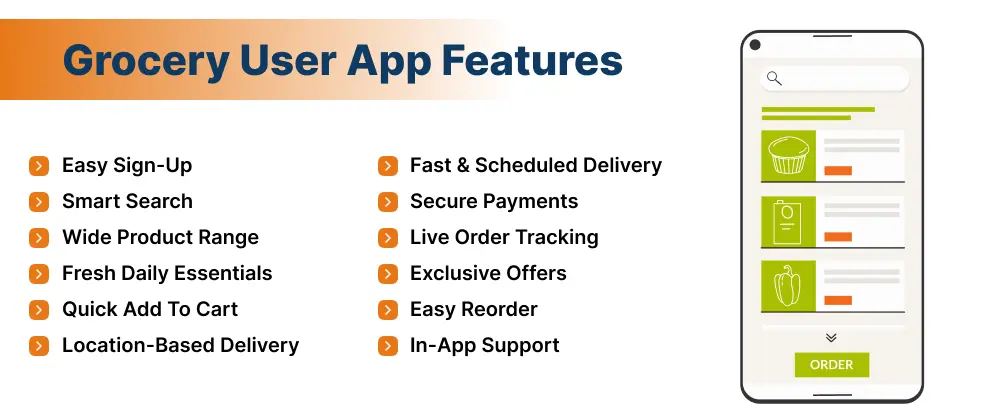
Grocery User App Features
The User App is actually the core feature of every food delivery app. They largely affects user experience with the app, as how consumers will be able to explore products, place orders, and use your food delivery app. A smooth user experience will not only boost conversions but also contribute to customer retention. The list below details a list of necessary and advanced features of a user app and how it affects the food delivery app development cost.
Feature
Cost Impact (USD)
User Registration & Login
$500 – $1,000
Product Catalog & Search
$1,500 – $3,000
Shopping Cart & Checkout
$1,000 – $2,500
Payment Gateway Integration
$1,200 – $3,000
Order Tracking (Live)
$2,000 – $4,500
Push Notifications
$800 – $1,500
Ratings & Reviews
$700 – $1,200

Delivery Partner App Features

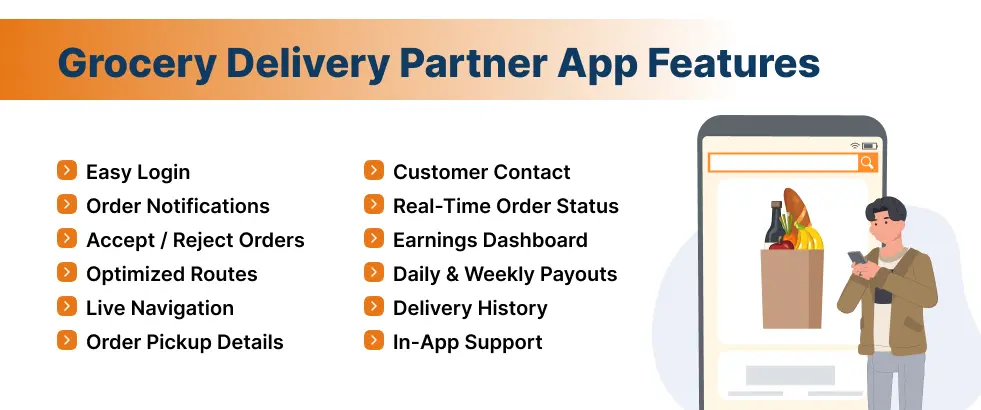
Grocery Delivery Partner App Features
The Delivery Partner App is a major part of a grocery delivery platform. The major advantage of a properly designed delivery partner app is a faster delivery time, along with fewer errors and a direct impact on customer satisfaction.
Feature
Cost Impact (USD)
Delivery Partner Login
$500 – $1,000
Order Assignment
$1,200 – $2,500
GPS & Route Navigation
$2,000 – $4,000
Order Status Updates
$800 – $1,500
Earnings Dashboard
$1,000 – $2,000

Admin Panel Features

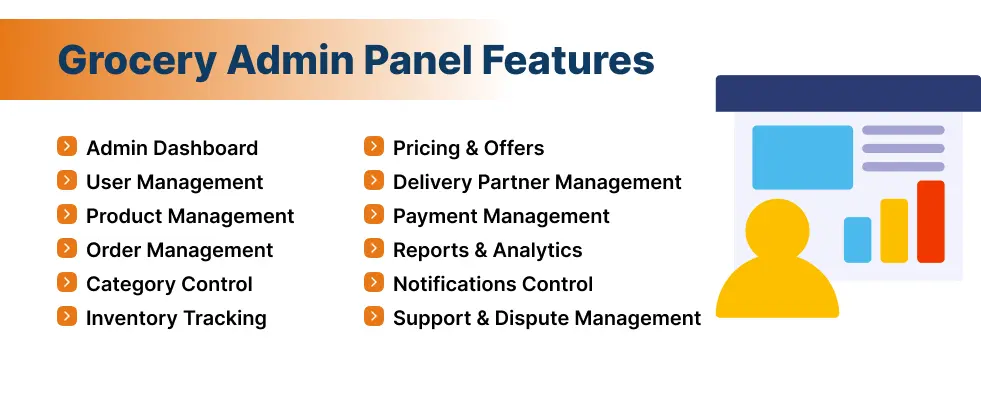
Grocery Admin Panel Features
The Admin Panel is the brain of a grocery delivery application. With the Admin Panel, the owners of any business or the operation team can handle the customers, orders, inventory, payment, as well as the performance in a single place. The customers, on the other hand, access the front end of the grocery delivery application.
Feature
Cost Impact (USD)
Admin Dashboard
$1,500 – $3,000
Order & User Management
$2,000 – $4,000
Inventory Management
$1,500 – $3,500
Vendor Management (Multi-store)
$2,500 – $5,000
Analytics & Reports
$2,000 – $4,000

Advanced Features

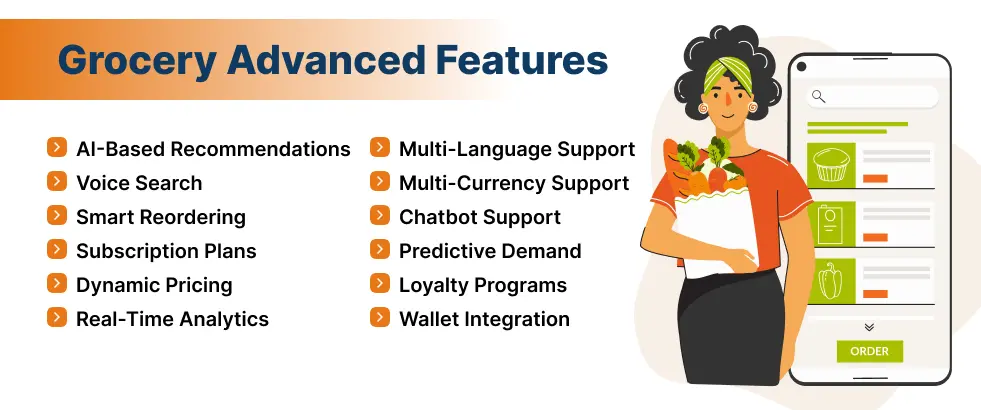
Grocery Advanced Features
The things which make an grocery delivery app unique in a crowded marketplace are the advance features and functionalities. The features and functionalities are not a must in an MVP, but they play an important role in increasing the customer experience and efficiency of a grocery delivery app. Moreover, it also affects the cost of grocery delivery app development.
Feature
Cost Impact (USD)
AI Product Recommendations
$3,000 – $8,000
Voice Search
$2,000 – $5,000
Loyalty Programs
$1,500 – $4,000
Subscription Plans
$2,500 – $6,000
Multi-language Support
$1,000 – $3,000
Chatbot / Live Support
$2,000 – $5,000

Factors Affecting Grocery Delivery App Development Cost

There are many factors that will define the cost of the grocery app. Major factors that influenced the grocery delivery app development cost are listed below:

1. App Platform

Costs are considerably affected by a decision on which platform to use. Development work in both Android and iOS, obviously, means double development work compared to development on just a platform, except if a cross-platform option is considered.
Platform Choice
Cost Impact 
Single Platform (iOS or Android)
$8,000 – $15,000
Both iOS & Android (Native)
$20,000 – $35,000
Cross-Platform (Flutter / React Native)
$15,000 – $25,000


2. App Design Complexity

A simple design is economical, but the end-users demand refined, user-friendly applications. Customized designs improve the user experience, as well as the brand identity, but the effort involves significant expenses of time and money.
Design Type
Cost Range
Basic UI (Templates, minimal animations)
$1,500 – $3,000
Custom UI/UX Design
$3,000 – $7,000
Advanced UX (Micro-interactions, animations)
$7,000 – $12,000


3. App Features & Functionality

The role of features is the most decisive factor in estimating the overall cost. The greater the features or third-party integrations, the higher the cost for development. Basic features are necessary for any grocery delivery app, but advanced features such as AI, voice search, and loyalty programs drive up the cost.
Design Type
Cost Range
Basic MVP (Core features only)
$15,000 – $25,000
Mid-level App
$30,000 – $50,000
Advanced Grocery App
$60,000 – $100,000+


4. Technology Stack & Backend Infrastructure

The tech stack is a crucial component in understanding how your app would behave under heavy traffic, as well as with complex functionalities such as “real-time updates, payment, and delivery.
Design Type
Cost Range
Basic Backend Setup
$4,000 – $7,000
Scalable Cloud Backend (AWS / GCP)
8,000 – $15,000
Microservices Architecture
$15,000 – $25,000+


6. Third-Party Integrations​

Third-party integrations enhance app functionality, but they add to the development complexity and cost. They may also result in some recurring expenses, such as API costs.
Integration
Cost Impact
Payment Gateway
$1,200 – $3,000
Maps & GPS
$2,000 – $4,500
SMS / Email / Push Notifications
$800 – $1,500
Analytics & CRM Tools
$1,000 – $3,000


7. Advanced Features (Optional but Costly)

The app industry in the supermarket sector has stiff competition, and regular updates are required in order to ensure that your app stays current and functional. Regular updates of the operating system versions and the incorporation of new functionalities may incur additional costs.
Feature
Cost Impact
AI Recommendations
$3,000 – $8,000
Voice Search
$2,000 – $5,000
Loyalty & Subscription Models
$2,500 – $6,000
Real-time Analytics Dashboard
$2,000 – $6,000


8. Development Team Location (Hourly Rates)

Offshoring the development to India or Eastern Europe can significantly lower costs. However, hiring a local team in North America or Western Europe may be more expensive but offer advantages concerning communication and project management.
Region
Hourly Rate
India / Southeast Asia
$15 – $40/hr
Eastern Europe
$30 – $80/hr
Western Europe
$50 – $120/hr
USA / Canada
$70 – $150/hr


9. Testing, QA & Security

Testing is one of the most critical factors for ensuring that your app works perfectly, is free from bugs, and gives a smooth user experience. Poor testing can lead to a bad user experience and low ratings of apps, which directly reduces business.
Testing Level
Cost Impact
Basic QA
$1,500 – $3,000
Automated & Manual Testing
3,000 – $6,000
Security & Compliance Testing
$2,000 – $5,000


10. Maintenance & Ongoing Costs

Once your application is built, it needs to be marketed and gain users. While it is not part of the development cost, it’s an important factor in your budget. Right after the release, spreading the word and driving downloads will take a serious marketing effort.
Ongoing Expense
Annual Cost
App Maintenance
15–25% of development cost
App Maintenance
15–25% of development cost
Cloud Hosting
$100 – $1,000+/month
App Store Fees
$99/year (Apple), $25 one-time (Google)
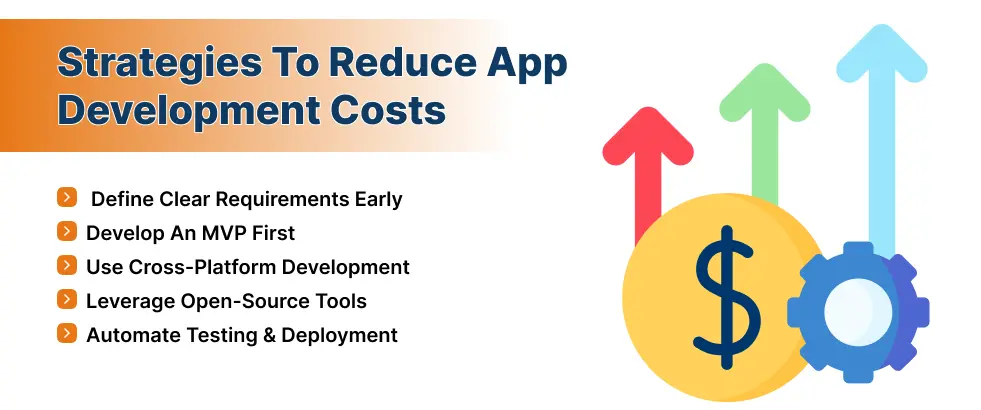
Strategies to Reduce App Development Costs

Build a Grocery Delivery App like Zepto With RG Infotech

If you are planning to develop an app like Zepto, then partner with RG Infotech; they will provide professional guidance for creating a fast and scalable grocery delivery app.
With their experienced developers, they will develop an app with a functioning system and capabilities such as real-time tracking, simple payment systems, a friendly app interface, and organized delivery management.
The app will be developed for proper functionality on both iOS and Android platforms with smooth connections for payment systems, maps, and so on.
Achieve your Grocery Delivery App project success with RG Infotech
Book a 15-minute consultation with our team that will drive your project to success. We prioritize your business values and goals that you want to achieve in the long run, and win a scalable income or profit out of it.

Conclusion

A grocery app is an investment in the future of retail. The average cost to develop a grocery delivery app can range from $20,000 to over $100,000. The key to building an app is to balance your budget with the quality of the user experience.
In a world where speed and convenience are the new currency, the well-crafted app is your ticket to long-term success. Want to begin your journey? Contact Us for your unique value proposition, choose the right technology partner, and go small to win big.
Your Grocery App journey begins here. Are you ready to deliver?

Frequently Asked Questions (FAQs)

The time required to develop a grocery delivery app typically varies from 3 to 6 months, depending on how complex an app you want to build, how many features you incorporate, and on which platform you decide to build it. The basic version of a grocery delivery app can be created in 3 months, while a feature-rich app can take up to 6 months.

On average, app maintenance costs around 15-25% of the initial development cost per year. Included in this category are bug fixes, updates to newer OS versions, the addition of new features, and general performance smoothing. For instance, if your application was developed for $40,000, you can very well expect the maintenance costs to range between $6,000 and $10,000 annually.

Yes, you can start with a basic MVP that includes only the core features: product listings, cart functionality, and basic payment options. In this case, your initial investment may be as low as $15,000 – $25,000. However, please note that while MVP can work for market testing, further development of advanced features such as AI, voice search, or route optimization will increase costs over time.

The critical attributes in a grocery delivery mobile app would be:

  • User Registration/Login
  • Product Catalog & Search   
  • The Product Catalog
  • Order Cart & Checkout:
  • Payment Gateway Integration
  • Order Tracking & Notifications
  • Delivery Partner Management

Such functionalities ensure a smooth experience in both shopping and delivering, as well as efficient functioning in the case of the delivery personnel and the administrators.

You can cut costs by:

  • Starting with the MVP first: Begin with the minimal version of your app with all must-have functionalities.
  • Choosing the cross-platform development approach: Using Flutter or React Native to develop applications for both iOS and Android platforms for less money.
  • Outsourcing the development phase: They can also involve hiring a development team from regions where the cost per hour is lower, for instance, India or Eastern Europe.
  • Emphasize key features: Focus on features that matter to your users, and save the advanced features for future upgrades.


SERVING IN 70+ COUNTRIES FOR MOBILE APP DEVELOPMENT

United States (USA), United Kingdom (UK), Singapore, Germany, Canada, Australia, Ireland, Dublin, New Zealand, Netherlands, Norway, United Arab Emirates (UAE), Saudi Arabia, Qatar, Kuwait, Finland, Mexico, Switzerland, Spain, France, etc.

4.9 / 5.0 by 1250+ customers for 1500+ Web, Games and Mobile App Development Projects.

DMCA.com Protection Status © 2007-2026 RG Infotech, USA & India. All Rights Reserved. Protected by Copyscape